

How Safe Is the Soulard Neighborhood in St. Louis?
By Aaron Eller, Founder — Cash Offer Man | St. Louis, Missouri
April 25, 2026
Soulard is one of the most beloved and most talked-about neighborhoods in St. Louis — and one of the most misunderstood when it comes to safety. Ask a South City resident who has lived there for 20 years and they will tell you it is a vibrant, walkable, historically rich community they would not trade for anything. Ask a suburban family who has never set foot south of Chouteau Avenue and they will express vague hesitation based on its proximity to other South City neighborhoods with higher crime profiles.
The truth, as usual, lies in the data — and in the nuance that raw crime statistics almost always require.
I am Aaron Eller, founder of Cash Offer Man, a local home buying company in St. Louis. I have bought, renovated, and sold homes throughout South City. I know Soulard’s blocks intimately — the safe ones, the ones that require more situational awareness, and the ones where the crime data concentrates. I have worked with buyers considering a Soulard purchase who needed honest guidance rather than either cheerleading or fear. This article provides that honest guidance.
The answer to “How safe is Soulard?” is not a single number. It is a map, a time-of-day consideration, a type-of-crime analysis, and a comparison to the neighborhoods around it. All of that, with the real data behind it, is what follows.
The Crime Statistics of Soulard in St. Louis, MO
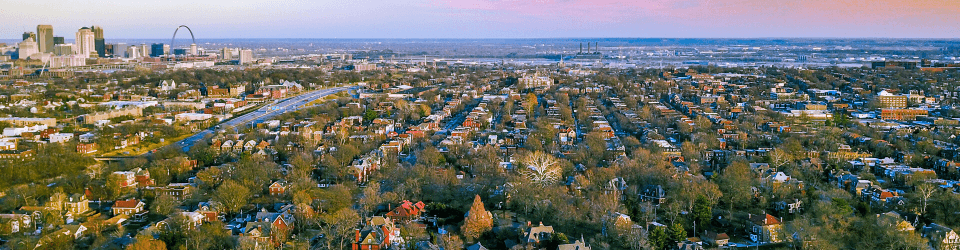
Before interpreting the data, you need to understand why Soulard’s crime statistics look the way they do — and why they overstate the danger for residents while potentially understating it for certain categories of visitors.
Soulard’s Overall Crime Rate and Grade
The overall crime rate in Soulard is 75.64 per 1,000 residents in the typical year. CrimeGrade.org assigns Soulard a D- overall safety grade, ranking it in the 8th percentile for safety — safer than 8% of neighborhoods but less safe than 92%.
Those numbers sound alarming. Before you close this tab, read the critical context that every piece of Soulard crime data requires.
The Visitor Traffic Problem With Per-Capita Crime Rates
When interpreting the Soulard crime map, keep in mind that crime rates are measured per resident. Areas with high visitor traffic, such as shopping districts, may appear to have higher crime rates simply because more crimes occur where people gather — even if few residents live there.
Soulard has approximately 4,200 to 4,500 residents. On a busy Saturday night, the neighborhood’s bars, restaurants, and event venues draw crowds that dwarf the resident population. During Mardi Gras weekend, an estimated 200,000 to 300,000 people pass through a neighborhood of 4,200 residents. That ratio — visitors to residents — is among the highest of any urban neighborhood in the Midwest. When a crime occurs anywhere in Soulard during one of these high-traffic periods, it is counted against a denominator of 4,200 people even though 50,000 were present. The per-capita crime rate for Soulard is almost meaningless as a safety metric for residents because of this mathematical distortion.
The more honest metric is the total crime count — the raw number of incidents — compared to the actual resident experience. The northeast parts of Soulard see the most incidents — about 122 total per year. In contrast, the northwest part of the neighborhood has the fewest, with approximately 0 crimes annually.
Violent Crime in Soulard: The Numbers That Actually Matter
The violent crime rate in Soulard is 10.47 per 1,000 residents in the typical year. The northeast parts of Soulard see the most violent crime incidents — about 19 per year. The northwest part of the neighborhood has the fewest, with approximately 0 crimes annually.
19 violent crimes per year in the highest-concentration area. For context: the Wells-Goodfellow neighborhood in North City — one of the most distressed neighborhoods in the city — records violent crime rates more than 600% above the national average. Soulard’s violent crime picture, concentrated in the northeast entertainment corridor and virtually absent in the residential blocks to the south and west, reflects a neighborhood where the danger is specific and avoidable rather than ambient and pervasive.
Soulard residents generally consider the southeast part of the neighborhood to be the safest. This is consistent with what longtime Soulard homeowners will tell you: the blocks south of Russell and east of 7th Street, away from the entertainment strip, are genuinely quiet residential blocks where families have lived for decades.
Property Crime: The More Frequent Risk
The property crime rate in Soulard is 43.99 per 1,000 residents in the typical year. The northeast parts of Soulard see the most property crime incidents — about 73 per year.
Property crime — primarily vehicle break-ins, theft from vehicles, and to a lesser extent burglary — is the most practically relevant crime category for Soulard residents and visitors. It is concentrated in the areas with the highest foot and vehicle traffic: the blocks around the Soulard Market, the restaurant and bar corridor on Soulard and 9th Streets, and the parking areas that serve the entertainment district.
The popular Soulard neighborhood missed ranking in the top 10 most dangerous neighborhoods in St. Louis City by less than 100 crimes in one recent reporting period — a data point that sounds concerning until you recognize that this reflects total crime count in a high-traffic entertainment district, not the lived experience of the people who actually reside there.
Where in Soulard Does Crime Concentrate?
Understanding the geography of crime in Soulard is the single most useful safety tool for residents, prospective buyers, and visitors. This is not a uniformly high-crime neighborhood. It is a neighborhood with specific crime concentration zones surrounded by genuinely quiet residential blocks.
The Northeast Entertainment Corridor — Highest Crime Concentration
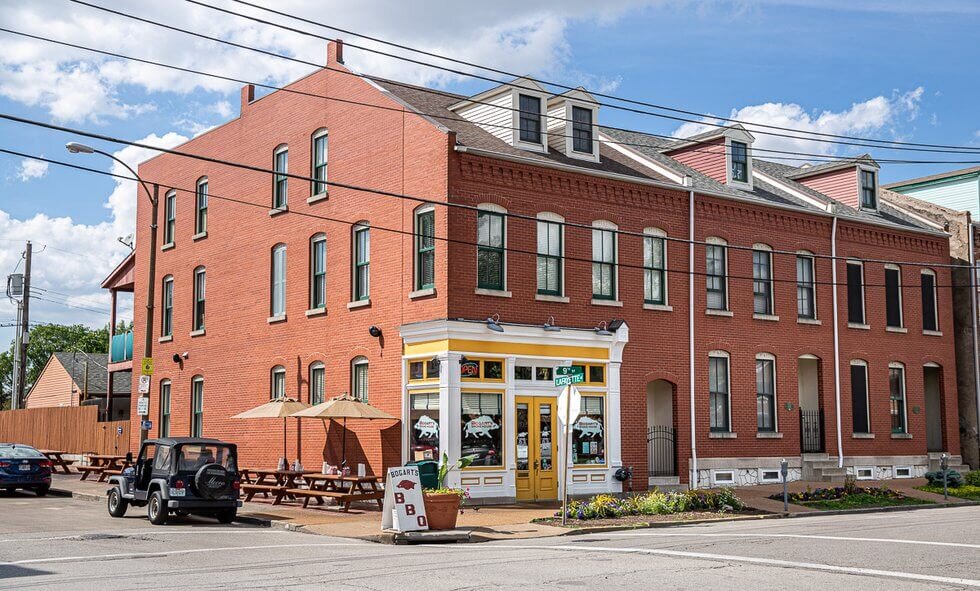
The northeast section of Soulard — centered on the intersection of 7th Street and Soulard Street, extending north toward Chouteau and east toward the riverfront — is where the majority of both violent and property crimes occur. This is also the neighborhood’s commercial and entertainment heart: the Soulard Market area, the highest-density bar corridor, and the blocks that see the most foot traffic from visitors who are not residents.
The crime that occurs here is predominantly what criminologists call “hot spot” crime — incidents that cluster around high-traffic entertainment venues, particularly during late-night hours. Bar fights, disorderly conduct, intoxicated driving, car break-ins in parking areas, and occasional robbery targets of intoxicated or distracted visitors are the incident types that dominate the northeast corridor’s crime log.
This crime is real. It is also largely predictable in time and geography. A Soulard resident who does not frequent the bar corridor at 1 a.m. on a Saturday has a dramatically different safety experience than a visitor who does.
The Residential Core — South and West Soulard
The residential blocks of Soulard south of Russell Boulevard and west of 7th Street — the blocks of brick rowhouses, restored Victorian homes, and the tight-lot working-class architecture that defines the neighborhood’s character — have a fundamentally different safety profile than the entertainment corridor. These blocks are where families live, where dogs get walked on weekday evenings, and where the neighborhood’s genuine community life occurs.
Residents generally consider the southeast part of the neighborhood to be the safest. The blocks around Sidney Street, Ann Street, and the residential corridors between Gravois Avenue and the market area are consistently described by longtime residents as comfortable and well-maintained. Property crime exists here — no South City neighborhood is immune to vehicle break-ins — but the concentrated violent crime of the entertainment corridor is largely absent.
The Perimeter Blocks — Where Context Matters Most
The northern edge of Soulard, where the neighborhood borders Downtown and LaSalle Park, and the eastern blocks toward the riverfront, carry more ambient risk than the interior residential core. These transition zones between Soulard and higher-crime adjacent areas are where situational awareness matters most for residents and visitors walking after dark.
How Does Soulard Compare to Neighboring St. Louis Neighborhoods?
Context matters enormously in St. Louis crime analysis. The city’s neighborhood-by-neighborhood variation is extreme — safe and unsafe blocks can be separated by a single street. Understanding where Soulard sits in the citywide spectrum clarifies the picture.
Soulard vs. Benton Park and Benton Park West
Benton Park, directly to the west of Soulard, and Benton Park West, further west, are among South City’s safest neighborhoods. Benton Park ranks 7th on the safest neighborhood list in St. Louis City. These neighborhoods have lower crime rates than Soulard, lower entertainment district traffic, and a more uniformly residential character. Buyers who want the South City aesthetic but are concerned about Soulard’s crime numbers should evaluate Benton Park as a comparable alternative.
Soulard vs. Downtown and LaSalle Park
Downtown St. Louis and LaSalle Park, which border Soulard to the north, have seen elevated crime spread throughout many areas of downtown and even the core business district over the last 5 to 10 years. Soulard’s southern residential blocks are notably safer than the downtown corridor that neighbors its northern boundary.
Soulard vs. Gravois Park and Dutchtown
Gravois Park ranks among the top 10 most dangerous neighborhoods in St. Louis City. In Dutchtown, crime costs $1,547 per person, which is $294 more than in Soulard. By comparison, Soulard looks considerably safer than the neighborhoods directly to its south and southwest.
What Types of Crime Should Soulard Residents and Visitors Watch For?
Vehicle Break-Ins and Theft From Vehicles — The Primary Risk
This is the crime that affects the most Soulard residents and visitors on a practical level. Vehicle break-ins cluster in surface parking lots, street parking adjacent to the bar corridor, and areas with high vehicle turnover and limited natural surveillance. The northeast entertainment corridor — particularly the blocks around the Soulard Market and the 9th Street bar strip — sees the highest concentration.
The profile: Opportunistic. A smashed window in seconds. Valuables left visible on a seat. Perpetrators are typically not targeting specific vehicles — they are scanning for visible opportunity. A bag, a laptop, a phone charger, a gym bag.
The mitigation: Remove everything from your vehicle every time you park in Soulard, day or night. Do not leave anything on seats, in cup holders, or on floorboards that is visible through the window. This single behavioral change eliminates the vast majority of vehicle theft risk.
Robbery and Assault — Concentrated in Time and Place
The violent crime that occurs in Soulard is heavily concentrated in the entertainment corridor during late-night hours, particularly on weekend nights and during major events. The profile is consistent with entertainment district crime nationally: altercations between intoxicated patrons, targeted robbery of individuals walking alone late at night after leaving bars, and occasional escalation of bar-related disputes into assaults.
This category of crime is both real and avoidable. A Soulard resident or visitor who:
- Uses rideshare for late-night bar-to-home transport rather than walking alone
- Travels in groups on the bar corridor after midnight
- Avoids public displays of expensive items (phones, jewelry) in the entertainment district after dark
- Leaves crowded venues before the late-night crowd peaks (roughly 12:30 to 2:00 a.m.)
…has dramatically reduced exposure to the violent crime that the statistics capture. This is not victim-blaming — it is the practical application of what criminologists call routine activity theory: crime requires a motivated offender, a suitable target, and the absence of capable guardianship. Managing the second and third factors reduces exposure.
Residential Burglary — Lower Than Statistics Suggest
Residential burglary in Soulard is notably lower than in many comparable South City neighborhoods, in part because the neighborhood’s density, active street life, and community cohesion create natural surveillance that deters opportunistic break-ins. The rowhouse and townhouse architecture — where properties share walls and neighbors are genuinely close — provides informal watchfulness that detached single-family neighborhoods lack.
The risk is not zero, but it is concentrated in properties adjacent to the entertainment corridor and along the northern perimeter. Interior residential blocks have very low burglary rates.

The Events Calendar — What Safety Looks Like During Soulard’s Major Events
Soulard hosts several of St. Louis’s largest and most attended events. Understanding the safety landscape during these events is essential for residents and visitors alike.
Soulard Mardi Gras — The Biggest Event West of New Orleans
Soulard Mardi Gras is the second-largest Mardi Gras celebration in the United States, drawing an estimated 200,000 to 300,000 attendees across the celebration’s multiple weekends in January and February, culminating on Fat Tuesday. The neighborhood hosts the Grand Parade (one of the largest Mardi Gras parades in the country), numerous block parties, and a period of sustained festivity that transforms the neighborhood for approximately six weeks.
Safety during Mardi Gras: SLMPD deploys a significant police presence throughout the celebration, including mounted officers, bicycle units, and foot patrols specifically concentrated in the entertainment corridor. The Soulard Special Business District works closely with police to coordinate security.
The crime that does occur during Mardi Gras is primarily intoxication-related: disorderly conduct, fights between patrons, and the occasional theft targeting visibly intoxicated visitors. Serious violent crime during the official event periods is relatively rare given the scale of attendance, in part because of the concentrated law enforcement presence.
Practical guidance for Mardi Gras attendance: Use designated parking outside the neighborhood and walk or rideshare in. Keep phones and valuables in front pockets or secure bags. Designate a sober person in your group. Know the address of where you are meeting your rideshare — the chaos of a 200,000-person event makes address recall difficult after several hours of celebration.
St. Patrick’s Day Parade — March Tradition
The Soulard St. Patrick’s Day parade and party, typically held on the Saturday before March 17th, draws tens of thousands of revelers in green to the neighborhood’s bars and streets. Similar to Mardi Gras in profile — high attendance, heavy alcohol consumption, concentrated police presence — and similar in safety dynamics. The principal risk is property crime in parking areas adjacent to the celebration zone and the opportunistic theft of distracted, intoxicated visitors.
Practical guidance: Same framework as Mardi Gras. Park outside, rideshare in, travel in groups after dark, secure valuables.
Soulard Farmers Market — Year-Round Community Anchor
The Soulard Farmers Market, operating Wednesday through Sunday, is a fundamentally different safety environment from the weekend bar scene. Daytime activity, community-oriented crowd, family-friendly atmosphere, and an entirely different type of visitor profile. Crime at the market itself is minimal. The surrounding parking areas carry the standard South City caution for vehicle break-ins, but the market is as safe an urban public market experience as you will find anywhere in Missouri.
Best times for safest visit: Wednesday through Friday mornings are when the market has the most local resident character and the least crowd pressure. Saturday morning is peak attendance and energy but remains a safe, family-friendly environment.
Bastille Day — July Festival
Soulard’s Bastille Day celebration in mid-July is a smaller, community-oriented street festival that captures the neighborhood at its most genuinely local. Attendance is in the thousands rather than the hundreds of thousands, the crowd skews toward neighborhood residents and regulars rather than the broader metro party crowd, and the safety profile is notably more relaxed than Mardi Gras or St. Patrick’s Day.
Housing in Soulard — What Buyers and Renters Need to Know
The Housing Stock and Prices
Soulard is defined architecturally by its 19th-century brick rowhouses, flounder homes (the distinctive half-roofed structures unique to early St. Louis French colonial architecture), and two-family flats that reflect the working-class immigrant community that built the neighborhood in the 1860s through 1900s. This housing stock is dense, beautiful, and in many cases meticulously restored. It is also old — virtually everything in Soulard predates 1920.
Current pricing (2025–2026): Renovated Soulard rowhouses and two-family flats are selling in the $280,000 to $420,000 range depending on renovation quality, square footage, and specific block location. The highest-demand blocks — those with the best-maintained neighboring properties, strongest community character, and greatest distance from the entertainment corridor — command premiums at the upper end of that range.
Entry-level properties — unrenovated or partially renovated row homes in need of work — can still be found in the $150,000 to $210,000 range on less-trafficked blocks, though the supply of these has been diminishing as the neighborhood’s renovation momentum has accelerated over the past decade.
Condominiums and conversions: Several Soulard properties have been converted to condominiums, providing entry into the neighborhood at lower price points — typically $180,000 to $275,000 — with the reduced maintenance burden of an HOA managing exterior and common area upkeep.
What Buyers Should Know Before Purchasing in Soulard
The Block Matters Enormously
Within Soulard’s roughly 0.75 square miles, the safety and quality-of-life experience varies more than the neighborhood’s small size would suggest. The difference between a block on Sidney Street three blocks from the entertainment corridor and a block on 9th Street directly adjacent to the bar strip is significant — in noise levels, in late-night foot traffic, and in the crime profile described in the earlier sections.
Before making an offer on any Soulard property, spend time on the specific block at different times of day and on a weekend night. The Saturday night experience at 11 p.m. will tell you more about what living on that block is actually like than any daytime showing.
Pre-1978 Construction and the Inspection Implications
Every building in Soulard predates 1978 — most predate 1910. This means federal lead paint disclosure requirements apply to every Soulard property transaction, and the actual presence of lead paint in original painted surfaces is common rather than exceptional. Buyers with young children should prioritize lead paint testing as part of their inspection contingency.
The aging plumbing systems in Soulard — original lead service lines from street to home are present in a significant percentage of properties — and the sewer laterals connecting to a very old municipal sewer infrastructure are the most consistent pre-purchase inspection concerns. A sewer lateral camera inspection ($200 to $400) is essential for any Soulard purchase. Clay tile laterals with root intrusion are the norm, not the exception, in a neighborhood of this age.
Tuckpointing is the other endemic maintenance issue. The brick exterior walls that give Soulard its visual character require periodic tuckpointing to remain structurally sound and weather-tight. Many older Soulard properties have areas of failed or deteriorating mortar that must be addressed. Budget for it as an ongoing ownership cost.
The Flood Zone Question
Some Soulard properties — particularly those near the northeastern edge of the neighborhood closer to the riverfront — may fall within or adjacent to FEMA-designated flood zones associated with the Mississippi River. Verify the flood zone designation at msc.fema.gov for any specific address before making an offer. Properties in Special Flood Hazard Areas require mandatory flood insurance that adds significant carrying cost. If your home has flood damage take these steps to remediate the problem.
The majority of Soulard’s residential core — the interior blocks well away from the riverfront — is not in the primary flood zone, but verification is essential rather than assumed.
Rental Market in Soulard
Soulard has a healthy rental market driven by young professionals, food and beverage industry workers (the neighborhood has one of the highest per-capita densities of restaurant and bar employment in the city), and urban-oriented residents who value walkability and neighborhood character over suburban amenity.
Apartment rents (2026): One-bedroom apartments in Soulard rowhouse conversions run approximately $850 to $1,250 per month. Two-bedroom units range from $1,100 to $1,600. Ground-floor units in converted two-family flats at the lower end of that range; renovated upper-floor units with historic architectural details at the upper end.
Safety considerations for renters: Ground-floor units directly adjacent to the entertainment corridor carry the highest property crime exposure — window and door security, motion-sensor lighting, and Simplisafe-type alarm systems are worth the investment. Upper-floor units in the interior residential blocks have minimal security concerns beyond standard urban precautions.
How to Stay Safe in Soulard — Practical Guidance for Residents and Visitors
For Residents
Vehicle Security
Park in your garage or private parking if you have access. If street parking is your only option, treat every departure as a permanent move — remove every item from the vehicle every time. Install a steering wheel club or visible deterrent on vehicles parked overnight on street-adjacent-to-entertainment-corridor blocks. The extra 30 seconds of inconvenience eliminates the most common crime category in the neighborhood.
Home Security
Install a video doorbell (Ring or Nest) and at least one exterior camera covering street-facing windows and entry points. Connect with the Soulard Neighborhood Association’s NextDoor community — it is active, useful, and provides real-time information about incidents and suspicious activity on specific blocks. Soulard has a strong neighborhood association culture that functions as a genuine community safety network.
The Soulard Special Business District (soulard-sbd.org) coordinates with SLMPD and publishes monthly crime reports. Bookmark it. Read it monthly. It gives you a specific, localized picture of what is happening on specific blocks rather than citywide statistics that obscure neighborhood variation.
Late-Night Awareness
If you are walking home after an evening out, walk with someone. The short walk from the bar corridor to the residential blocks is where the small number of personal robbery incidents tend to occur. A rideshare from bar to front door costs $5 to $8. It is worth every cent.
For Visitors
Park Smart
The parking areas most heavily targeted for vehicle break-ins are the large surface lots on the northern edge of the neighborhood nearest Chouteau and the street parking directly around the Soulard Market. Paid secure parking in smaller lots further from the entertainment corridor or parking in a garage reduces exposure. Leave nothing in the vehicle.
Travel in Groups After Dark
The entertainment corridor after midnight is where the neighborhood’s violent crime concentrates. In a group, you are dramatically less likely to be targeted for the opportunistic robbery that accounts for most of the incidents in that zone.
Know Your Exit
Before you go out, identify your rideshare pickup spot and have the app open on your phone. Getting out of the entertainment corridor cleanly at the end of the night — rather than waiting on a chaotic corner for a driver who cannot find you — reduces the window of vulnerability.
Things to Do in Soulard Beyond the Bars
Soulard’s identity in the broader St. Louis imagination is dominated by its nightlife, but the neighborhood’s genuine appeal for residents goes well beyond the bar scene.
The Soulard Farmers Market
Operating since 1779 — making it the oldest public market west of the Mississippi River — the Soulard Market is one of the great neighborhood institutions in St. Louis. Wednesday through Sunday, vendors fill the covered market building with fresh produce, meat, flowers, prepared foods, and crafts. Saturday morning is the peak experience: a genuine working urban market where longtime vendors know their regular customers by name and the building fills with the organized chaos of a market that has been operating continuously for nearly 250 years.
Architecture and Walking
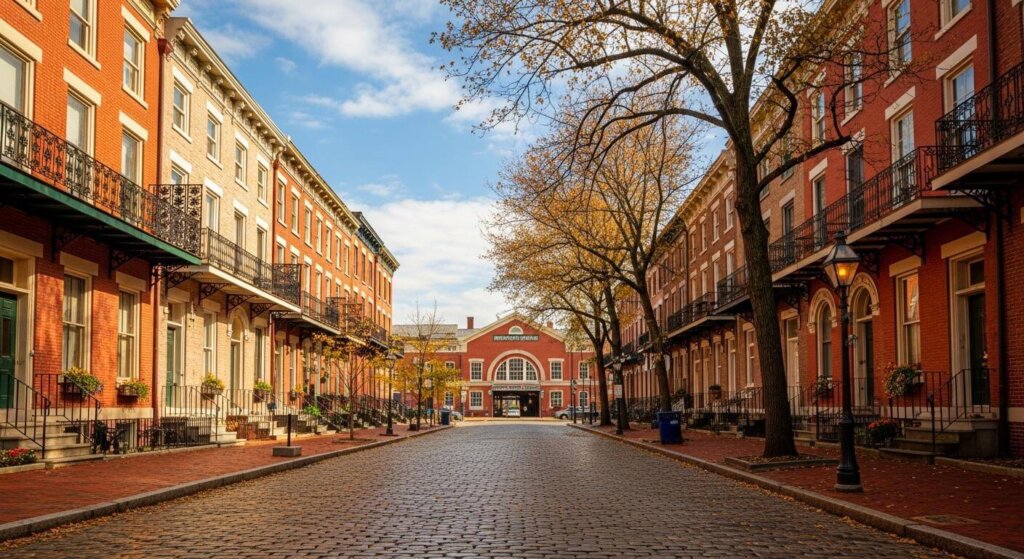
Soulard rewards walkers who pay attention. The residential blocks south of Russell are among the best-preserved examples of 19th-century working-class brick architecture in the Midwest — flounder houses, two-story rowhouses with cast iron railings, ornate doorway details, and the occasional glimpse of a courtyard garden through an open gate. The neighborhood has more architectural character per square block than almost anywhere in Missouri.
Dining Scene
Soulard’s restaurant scene has evolved significantly from its exclusively dive-bar-and-wings identity. The neighborhood now hosts a genuine range: Pieces Board Game Café, Joanie’s Pizzeria (a South City institution), Hammerstone’s for live music and late-night food, Frazer’s Restaurant (fine dining in a neighborhood setting), and rotating new concepts that reflect the neighborhood’s growing appeal to young professional residents.
Community Events and Neighborhood Life
Beyond Mardi Gras and St. Patrick’s Day, Soulard hosts Bastille Day in July, the Soulard Art Market, and numerous neighborhood association events that reflect a community with genuine civic investment. The Soulard Neighborhood Association (SNA) is one of the more active neighborhood organizations in St. Louis City, and its events calendar reflects a neighborhood that thinks of itself as a community rather than just a collection of bars.
Is Soulard the Right Neighborhood for You?
The safety question for Soulard comes down to lifestyle fit more than any categorical risk assessment.
If you are a young professional who values walkability, architectural character, a vibrant neighborhood culture, proximity to downtown and the medical corridor, and the energy of one of St. Louis’s most historically significant communities — and you are comfortable with the crime precautions that any urban entertainment district requires — Soulard is an exceptional choice. The safety concerns are real but specific and mitigable.
If you have young children and are primarily focused on neighborhood tranquility, quiet street life, and minimal late-night entertainment district traffic — Benton Park, Tower Grove South, or Compton Heights may serve you better with similar South City architectural character at comparable price points.
If you are an investor evaluating Soulard’s long-term appreciation trajectory: the neighborhood has been appreciating consistently, its housing stock is finite and irreplaceable, and its proximity to downtown and the medical employment corridor creates sustained rental demand. The safety profile, properly contextualized, is not an obstacle to investment — it is a known quantity that is already priced into the market.
At Cash Offer Man, we know Soulard’s housing stock and its safety dynamics well. If you are considering buying, selling, or investing in Soulard or surrounding South City neighborhoods, reach out. We provide honest, data-grounded guidance on what properties are worth and what to expect from the neighborhoods they are in — because our business depends on getting those answers right.
Summary: Soulard Safety by the Numbers
| Metric | Data |
| Overall crime rate | 75.64 per 1,000 residents |
| Violent crime rate | 10.47 per 1,000 residents |
| Property crime rate | 43.99 per 1,000 residents |
| Safest area within Soulard | Southeast residential blocks |
| Highest crime area within Soulard | Northeast entertainment corridor |
| Total violent crimes (NE corridor) | ~19 per year |
| Neighborhood population | ~4,200–4,500 residents |
| Mardi Gras attendance | 200,000–300,000 (vs. 4,200 residents) |
| Renovated home price range | $280,000–$420,000 |
| Entry-level/unrenovated price range | $150,000–$210,000 |
| 1BR apartment rent range | $850–$1,250/month |
| Safest comparable alternative | Benton Park (ranks 7th safest in St. Louis City) |
Aaron Eller is the founder of Cash Offer Man, a local home buying company serving St. Louis City, St. Louis County, and surrounding Missouri communities. For guidance on buying or selling in Shaw or any South City neighborhood, visit our website.
Get An Offer Today, Sell In A Matter Of Days