

Why Home Staging Will Help Your House Sell for More in 2026
By Aaron Eller, Founder — Cash Offer Man | St. Louis, Missouri
May 4, 2026
Staging a home is one of those topics where the real estate industry’s incentives and the homeowner’s interests happen to align perfectly — which makes it unusual in a business where that is not always the case. Staging costs money, takes time, and requires sellers to temporarily depersonalize the space they have called home. In exchange, it reliably produces higher offers, shorter time on market, and a buyer psychology that is measurably different from what an unstaged home generates.
The data on this is not ambiguous. The National Association of Realtors, the Real Estate Staging Association, and multiple independent research studies have consistently found that staged homes sell faster and for more money than unstaged comparable homes. In a market like St. Louis in 2026 — where we are the top-ranked first-time buyer market in the country, where more than one-third of homes go pending within seven days, and where the difference between a good listing and a great one can mean a $10,000 to $25,000 difference in final sale price — staging is not a luxury consideration. It is a financial decision.
I am Aaron Eller, founder of Cash Offer Man. Every property we sell has been deliberately staged. I have watched staged homes generate multiple competing offers on properties in neighborhoods where unstaged comparables sat for 45 days. I have seen the data, I have lived the results, and this article gives you the complete picture of why staging works and exactly how to do it for maximum return.
What Does the Data Say About Home Staging?
National Association of Realtors Staging Statistics
The NAR Profile of Home Staging is the most comprehensive industry survey on staging outcomes, conducted annually with both buyer’s agents and seller’s agents. The most recent data is unambiguous:
82% of buyers’ agents said staging made it easier for buyers to visualize the property as their future home — the core psychological mechanism that converts showings into offers.
23% of buyers’ agents reported that staged homes increased the dollar value offered by between 1% and 5%. On a $250,000 St. Louis home, a 1% to 5% increase represents $2,500 to $12,500 in additional sale proceeds.
Staged homes sell 73% faster than non-staged homes, according to Real Estate Staging Association (RESA) data. In the St. Louis market, where the average days on market is 26 to 33 days for well-positioned homes, a 73% faster sale means closing in 7 to 9 days rather than 26 to 33 — directly reducing carrying costs for the seller.
The average staging investment returns 586% according to RESA — meaning a seller who spends $1,000 on staging recovers approximately $5,860 in net sale proceeds above what they would have achieved unstaged. This figure reflects professional staging of key rooms, not whole-home furnished staging.
Professional staging costs: The average cost of a professional staging consultation in the United States is $300 to $600. Full home staging with rented furniture for a vacant property averages $2,500 to $5,000 for the first month. Owner-occupied staging (where the professional works with existing furniture) averages $800 to $1,500 for the consultation and placement service.
The St. Louis-Specific Case
In St. Louis’s current market — ranked in Zillow’s top 10 hottest markets nationally, with 33%+ of homes going pending within seven days — staging’s competitive advantage is amplified by one specific dynamic: the homes that generate first-week multiple offers are not simply the homes in the best locations. They are the homes that photograph best.
The online listing is where 97% of St. Louis buyers begin their search. A staged home photographs dramatically better than an unstaged one — and the gap between a staged home’s listing photographs and an unstaged home’s photographs is frequently the difference between a buyer scheduling a showing and moving to the next listing.
In a market where turnkey starter homes in solid school districts create genuine competition in days, staging is not about making a home look nice for in-person showings. It is about ensuring that the home passes the 8-second online scroll test that determines whether a serious buyer clicks for more photographs or keeps scrolling.
The Psychology of Staging — Why It Works
How Buyers Process Homes Emotionally
This is the mechanism that makes staging so powerful — and why it deserves more analysis than it typically gets.
Homebuying is an emotional decision disguised as a financial one. Buyers routinely tell themselves and their agents that they are making a rational investment calculation. The research on actual buyer decision-making tells a different story: most buyers make an emotional decision about a home within the first 60 to 90 seconds of entering it, and spend the rest of the showing looking for logical justifications for the emotional conclusion they have already reached.
This 60-to-90-second window is exactly what staging optimizes. A professionally staged home is designed to trigger positive emotional responses in the first moments of the showing: a sense of warmth and welcoming at the entry, a sense of space and light in the main living areas, a sense of functionality and modernity in the kitchen and baths, and a sense of retreat and comfort in the bedroom.
An unstaged or poorly staged home fails this window in ways that sellers almost never notice because they are blind to their own home’s visual presentation. The overstuffed living room that feels cozy to the owner reads as cramped to the buyer visualizing their furniture. The personal photographs that feel like a welcoming family home to the seller remind the buyer that this is someone else’s home. The accumulated furniture of 20 years of living that works functionally for the people living there communicates “no room for my stuff” to the buyer doing spatial math.
The Visualization Gap
The single most important finding in the NAR staging research — that 82% of buyers said staging helped them visualize the property as their future home — points directly to what unstaged homes fail to provide.
Buyers, particularly first-time buyers who represent 40% to 45% of the St. Louis market, have difficulty mentally editing an occupied, personalized, cluttered home into the vision of their own life in that space. When buyers cannot visualize themselves living in a home, they do not make emotional connections. When they do not make emotional connections, they do not make strong offers. When they do not make strong offers, the seller leaves money on the table.
Staging solves the visualization problem by removing the previous occupant’s visual identity from the home and replacing it with a neutral, aspirational presentation that allows every buyer who walks through to project their own life onto the space. This is not about creating a false impression — it is about removing the obstacles to buyer imagination that every occupied, personalized home inadvertently places in the buyer’s path.
Room-by-Room Staging Priorities — Where to Invest
Not all rooms have equal staging impact on sale price and speed. Understanding the hierarchy allows sellers to allocate staging budget where it produces the highest return.
The Living Room — The First Impression That Defines the Showing
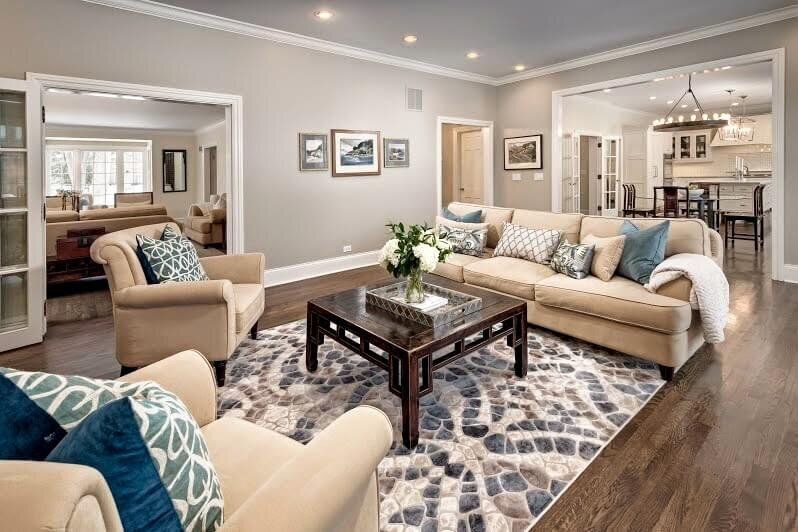
The living room is the first room most buyers encounter after the entry, and it is the room where the emotional tone of the entire showing is set. In St. Louis’s predominant housing stock — brick ranches and two-story homes from the 1950s through 1970s — the living room is typically the largest space in the home and the primary driver of “feel” in the listing photographs.
NAR data: 90% of staging professionals rate the living room as the most important room to stage — higher than the kitchen, higher than the primary bedroom.
What great living room staging accomplishes:
- Creates a clear traffic flow that makes the room feel larger than its dimensions
- Establishes a color palette that carries through the listing photographs cohesively
- Removes personal items (family photographs, religious objects, sports memorabilia) that remind buyers they are in someone else’s home
- Demonstrates scale — appropriately sized furniture shows buyers how their furniture will fit rather than leaving them guessing
Common living room staging mistakes St. Louis sellers make:
- Leaving too much furniture (the two sofas and three side tables that work for the family feel overwhelming in a showing)
- Oversized area rugs that chop the floor visually rather than anchoring the seating
- Dated window treatments that fight the light rather than welcoming it
- Gallery walls with dozens of family photographs — the most common visualization obstruction in St. Louis homes
The Kitchen — The Room That Sells the House
The kitchen is the room buyers spend the most time evaluating and the room most directly associated with offer price. Regardless of the kitchen’s actual quality or renovation level, staging can meaningfully improve its perceived value.
The clear counter principle: Every item on the kitchen counter that does not serve a display purpose should be removed before photographs and showings. The coffee maker, the knife block, the paper towel holder, the small appliances, the fruit bowl — all of it. A cleared counter makes every kitchen look larger, more modern, and more expensive than the same kitchen with the standard accumulation of counter items.
Three low-cost, high-impact kitchen staging moves:
- Remove everything from the counters. Everything. Store it under the sink or in a cabinet.
- Add one simple, stylish element in a current finish — a white ceramic bowl with lemons or green apples, a small potted herb, a cutting board with artisan bread — that provides warmth without clutter.
- Update the hardware. Cabinet pulls and knobs are a $150 to $300 investment that makes a dated kitchen look intentionally updated in listing photographs.
What staging cannot substitute for: If the kitchen has genuine structural or functional issues — non-working appliances, cracked countertops, failing cabinet doors — staging amplifies the quality of what exists but cannot create quality that does not exist. Minor kitchen preparation (deep cleaning, hardware update, strategic prop placement) delivers maximum return; staging over fundamental kitchen deficiencies is less effective.
The Primary Bedroom — Creating the Retreat Impression
The primary bedroom is the room buyers use to decide whether the home is worthy of their long-term investment in the space where they will begin and end every day of their lives. It is a more personal evaluation than any other room in the home.
NAR staging data on bedrooms: 78% of staging professionals include the primary bedroom in their top three staging priorities alongside the living room and kitchen.
The bed as anchor: The bed is the visual focal point of every bedroom photograph. A well-made bed with a cohesive set of quality bedding — neutral tones, coordinated pillows, a folded throw at the foot — communicates care and quality more than any other single staging element. If the current bedding is mismatched, dated, or patterned in a way that fights with the room’s paint or flooring, a $150 to $300 bedding investment is among the highest-return staging expenditures available.
Furniture editing in the bedroom: The cardinal rule of bedroom staging is that the floor must be visible. Buyers are doing spatial calculations as they walk through a bedroom — “where does my dresser go, where does my reading chair go, do my nightstands fit?” A bedroom where the floor is partially visible around a well-placed bed and minimal furniture answers those questions. A bedroom packed with every piece of furniture the seller owns raises those questions while providing no way to answer them.
Bathrooms — The Detail That Signals Care
Bathrooms are evaluated not for their size — most buyers understand the bathroom footprint in a given price range — but for their cleanliness and perceived maintenance quality. A bathroom is the most intimate space in a home, and the emotional response to it is almost entirely determined by cleanliness and presentation rather than quality of fixtures.
The bathroom staging checklist:
- Remove every personal item from the counter — toothbrush, soap dispenser, razors, medications, hair tools
- Replace the hand soap with a clean, coordinated dispenser
- Remove old towels and hang fresh, folded white or neutral towels (white towels photograph as hotel-quality regardless of their actual cost)
- Close the toilet lid in every photograph
- Add one simple element — a small plant, a candle, a neutral bath mat — that provides visual warmth
A bathroom that has been properly prepared for staging looks cleaner and more cared for than an identical bathroom that has not been prepared, regardless of the actual quality of the fixtures. The perceived quality differential drives buyer valuation.
Vacant vs. Occupied Staging — Two Different Problems
Staging an Occupied Home
The primary challenge of staging an occupied home is editing — helping the seller see their own home through a buyer’s eyes and make the changes that are psychologically difficult but financially necessary.
The occupied home staging process:
- Declutter first. Remove approximately one-third of everything in every room — books, decorative items, furniture, clothing visible in closets. Rent a storage unit if necessary. The $100 monthly cost of a storage unit is the single best staging investment most sellers can make.
- Depersonalize. Remove family photographs from all common areas. This is the change sellers most resist and the one that matters most. The buyer needs to visualize their family in this space, not yours.
- Deep clean to a professional standard before any other staging work. Staging over dirty surfaces is self-defeating. A dirty home communicates neglect regardless of how the furniture is arranged.
- Engage a professional stager for a consultation ($300 to $600 in St. Louis). A stager with fresh eyes will identify the issues the seller has stopped seeing and prescribe specific changes with specificity that a general “declutter and clean” directive cannot achieve.
- Stage with your existing furniture, supplemented by inexpensive props from Target, HomeGoods, or TJ Maxx.
Staging a Vacant Home
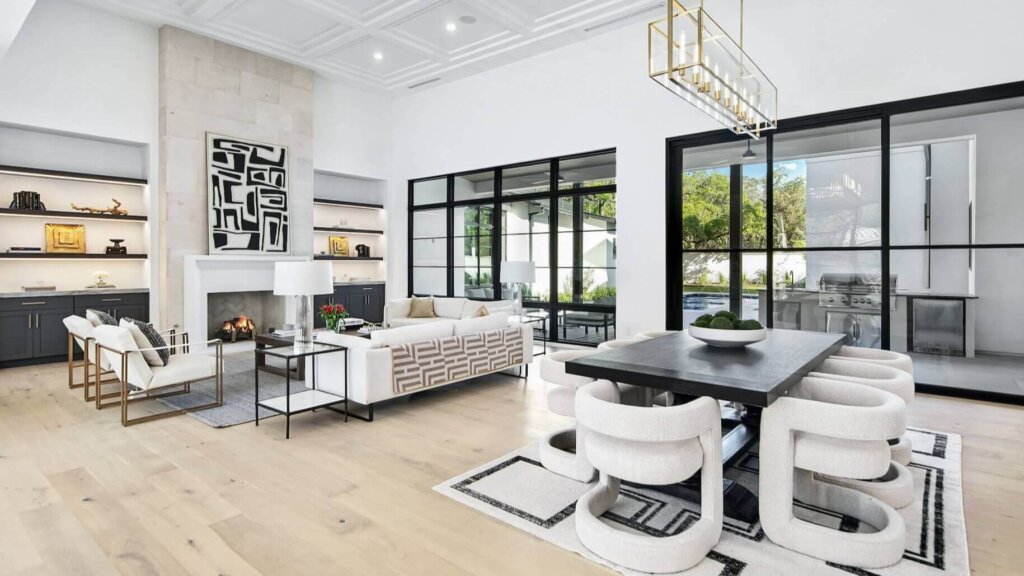
Vacant homes present the opposite challenge from occupied homes: rather than too much content obscuring the space, there is no content at all — and buyers consistently struggle to evaluate empty rooms accurately.
Research from Coldwell Banker found that vacant homes sell at a 6% price discount compared to staged-occupied and professionally staged vacant homes. On a $250,000 St. Louis home, that discount is $15,000. Professional staging of a vacant home costs $2,500 to $5,000 for the first month — a trade of $5,000 to recover $15,000.
The specific challenge of vacant rooms: Buyers consistently underestimate the size of empty rooms and overestimate the size of furnished rooms in physical showings (the opposite of what most people expect). An empty bedroom of 12 by 14 feet looks smaller than a furnished bedroom of the same dimensions because there is no reference for scale. Buyers who walk into vacant rooms leave with concerns about whether their furniture will fit — concerns that the right furniture placement would eliminate.
For vacant St. Louis homes: Cash Offer Man stages every renovated property we sell. We do this not because it is an industry convention but because we have seen the direct correlation between professional staging and the speed and strength of offers. Every property we stage with the right furniture and props in the right configuration generates stronger buyer response than the same space empty. The data within our own portfolio is consistent with the national research.
The ROI Calculation for St. Louis Sellers
Let’s put the numbers together specifically for the St. Louis market.
Scenario: A 3-bedroom, 2-bathroom St. Louis County home listed at $249,000. Average comparable homes without staging are selling at $240,000 to $245,000 after 35 to 45 days on market with one round of price reduction.
Staging investment:
- Storage unit for excess furniture (2 months): $200
- Professional staging consultation and placement (occupied home): $950
- Targeted prop purchases (bedding, bathroom accessories, kitchen items, plants): $450
- Deep professional cleaning: $450
- Total staging investment: $2,050
Staging outcomes based on NAR and RESA data applied to St. Louis pricing:
- Estimated sale price with staging: $252,000 to $256,000 (conservatively 1.2% to 2.8% above comparable unstaged homes)
- Time on market: 8 to 14 days (vs. 35 to 45 days)
- Carrying cost savings (2 months of mortgage, taxes, utilities avoided): approximately $3,400
- Price premium above unstaged: approximately $7,000 to $11,000
Net return on $2,050 staging investment: $7,000 to $11,000 + $3,400 in carrying costs = $10,400 to $14,400
That is a return of 500% to 700% on the staging investment. At this ratio, the question for any St. Louis seller is not whether staging is worth the money. It is whether you can explain not doing it.
What Staging Cannot Fix — Knowing the Limits
In the interest of complete honesty, staging has real limitations that sellers should understand before relying on it as the solution to every listing challenge.
Staging cannot substitute for pricing. An overpriced home that is beautifully staged will eventually sell for less than a correctly priced home that is modestly staged. Staging amplifies the value of correct pricing — it does not replace it.
Staging cannot hide deferred maintenance. A staged home with a visibly failing roof, a non-functional HVAC system, or significant structural issues will attract buyer interest but then generate lower offers or post-inspection concession demands that recover what the staging premium generated. The preparation article elsewhere on this site covers how to think about mechanical and structural work before listing.
Staging cannot compete with fundamental location issues. The buyer who does not want to be adjacent to a commercial property or on a high-traffic street will not be converted by any staging. These issues require pricing responses, not staging responses.
Cash Offer Man’s Alternative for Sellers Who Skip Staging
Not every St. Louis seller is in a position to stage — financially, logistically, or in terms of the property’s actual condition. For sellers dealing with distressed, dated, or estate properties that are beyond the scope of conventional staging preparation, or for sellers who simply need a clean, fast exit without the preparation process, Cash Offer Man provides a direct alternative.
We buy homes in any condition, in any state of preparation, for cash. No staging required. No cleaning. No showings, no open houses, no listing photographs. A fair cash offer within 24 hours of the walkthrough, and a close on your timeline.
The staged, listed path is the right choice for sellers whose property and circumstances support it — and when it is executed correctly, the financial results justify every dollar spent. The Cash Offer Man path is the right choice when the preparation process is not viable. Both options are legitimate; understanding which one fits your situation is what this entire body of work is designed to help you determine.
Summary: Home Staging Data at a Glance
| Metric | Data |
| Buyers who say staging helps visualization | 82% (NAR) |
| Buyers’ agents reporting 1–5% offer increase | 23% (NAR) |
| Faster sale (staged vs. unstaged) | 73% faster (RESA) |
| Average ROI on staging investment | 586% (RESA) |
| Vacant home price discount vs. staged | 6% (Coldwell Banker) |
| Professional staging consultation cost (St. Louis) | $300–$600 |
| Full vacant home staging cost (first month) | $2,500–$5,000 |
| Occupied home stager consultation cost | $800–$1,500 |
| Most important room to stage | Living room (90% of pros) |
| Second most important room | Kitchen |
| Third most important room | Primary bedroom |
| Estimated staging ROI (St. Louis $249K home) | 500–700% ($10,400–$14,400 net return) |
| St. Louis homes going pending in <7 days | 33%+ |
| Key staging mistake (most common) | Personal photographs in common areas |
Aaron Eller is the founder of Cash Offer Man, a local home buying company serving St. Louis City, St. Louis County, and surrounding Missouri communities. For sellers who want to stage and list for maximum value, or for those who want a direct cash offer with no preparation required, visit CashOfferMan.com. Check out some of our other posts like the current best and worst neighborhoods in St. Louis to buy or sell a home or our article on why the tax liens are rising across St. Louis and how to protect yourself from falling behind on your property taxes.
Get An Offer Today, Sell In A Matter Of Days