

My House Has Foundation Issues: A Complete Guide to Understanding, Assessing, and Fixing the Problem
By Aaron Eller, Founder — Cash Offer Man | St. Louis, Missouri
May 17, 2026
Few phrases in residential real estate produce more immediate anxiety than “foundation issues.” The words carry a weight that no other home problem does — a sense that the very ground your home stands on is compromised, that everything built on top of it is at risk, and that the cost to fix it will be catastrophic. Some of that anxiety is justified. Some of it is not. The challenge is knowing the difference.
The truth is that foundation conditions exist on a wide spectrum. At one end: a small vertical crack in a poured concrete basement wall from normal concrete shrinkage — a cosmetic condition that has been stable for 30 years and requires nothing. At the other: a bowing block wall under hydrostatic pressure that has moved three inches over five years and will continue moving until it fails, taking the first floor above it with it. Between these extremes is a vast middle ground of conditions that require varying levels of concern, monitoring, or repair.
I am Aaron Eller, founder of Cash Offer Man. I have walked through more St. Louis foundations than most people will encounter in a lifetime. I have seen every type of foundation condition the St. Louis market produces — the clay soil heave, the hydrostatic pressure bowing, the differential settling from uneven soil compaction, the long-horizontal crack from decades of water infiltration. I know what to be concerned about and what can wait. This article gives you the complete picture.
Understanding St. Louis Foundation Types and Why They Matter
Poured Concrete vs. Block vs. Stone
Before discussing what can go wrong, understanding what type of foundation your home has changes how you interpret every condition you find.
Poured concrete foundations: Common in St. Louis homes built after approximately 1960. A continuous monolithic pour of concrete that, when properly executed, is among the most structurally sound residential foundation types. Poured concrete is stronger in tension than block and more resistant to hydrostatic pressure. Cracks in poured concrete are common but typically more localized and less structurally threatening than equivalent cracks in block.
Concrete block (CMU) foundations: Common in St. Louis homes built from the 1930s through the 1960s. Individual 8-by-8-by-16-inch concrete masonry units stacked in courses and mortared together. Block walls are strong in compression but significantly weaker than poured concrete in lateral resistance — they cannot withstand the same horizontal force from soil pressure. A bowing block wall is a fundamentally more serious condition than a bowing poured concrete wall of the same dimensions.
Stone or brick foundations: Found primarily in St. Louis homes built before 1920. Rubble stone, cut stone, or brick laid in lime mortar. These foundations have a different failure mode than concrete — they can shift, lean, deteriorate at the mortar joints, or simply lose cohesion over time as mortar deteriorates. Many St. Louis South City properties with stone foundations are remarkably sound despite their age; others have reached the point where foundation replacement is the only viable solution.
The St. Louis Soil Problem
St. Louis’s subsoil contains a significant clay component — specifically, expansive clay that absorbs water and swells, then contracts as it dries. This seasonal expansion and contraction cycle is the primary driver of foundation movement in the St. Louis metro area.
In spring, as Missouri receives 40 inches of annual rainfall, clay soils absorb moisture and expand. In summer and fall, as the soil dries, it contracts. Over years and decades, this cycle — combined with the specific drainage patterns around each individual foundation — produces the differential settling, cracking, and movement that St. Louis foundation contractors address daily.
The implication: a St. Louis foundation condition that appeared stable last fall may have moved by spring after significant rainfall, and vice versa. Monitoring foundation conditions across seasons is more informative than a single inspection.
The Crack Types — Reading the Foundation’s Message
The first thing every St. Louis homeowner should understand about foundation cracks is the directional rule that distinguishes cosmetic concerns from structural emergencies.
Vertical Cracks — Generally Less Severe
What they look like: Straight or slightly irregular cracks running from floor to ceiling (or top to bottom of a wall section) in a predominantly vertical orientation.
What typically causes them: Concrete shrinkage as the original pour cures is the most common cause of vertical cracks in poured concrete foundations — a normal, expected part of the concrete curing process. Most poured concrete foundations have at least a few hairline vertical cracks from the original cure. Differential settling — when one portion of the foundation settles more than an adjacent portion — can also produce vertical or near-vertical cracks.
The key evaluation factors:
- Width: A hairline crack (less than 1/16 inch) with stable edges is far less concerning than a crack wider than 1/4 inch.
- Displacement: Are the two sides of the crack at the same depth (flush), or has one side moved inward or outward relative to the other? Any lateral displacement is more concerning than a flush crack.
- Moisture: Is water actively infiltrating through the crack? Wet cracks require attention even if the crack itself is narrow.
- Activity: Is the crack growing? Tracking a crack with pencil marks at the end of the crack and dates is the simplest monitoring tool available. A crack that has not grown in 12 months is more reassuring than one that extended 2 inches since summer.
When to act on a vertical crack: A vertical crack wider than 1/4 inch, showing any lateral displacement, actively leaking water, or showing evidence of recent growth warrants professional structural evaluation. A hairline vertical crack that has been stable for years and shows no moisture penetration can typically be monitored and, if desired, sealed cosmetically.
Average cost of professional evaluation: $200 to $600 for a structural engineer’s assessment. Do not rely solely on foundation contractor evaluations — contractors have a financial interest in recommending repair. A structural engineer’s independent assessment is worth the cost.
Horizontal Cracks — The Most Serious Warning Sign
What they look like: Cracks running horizontally across the face of a foundation wall, often approximately one-third to one-half of the way up from the floor — where the lateral soil pressure is greatest.
Why they are serious: Horizontal cracks in a foundation wall — particularly a block wall — are evidence of lateral force from soil pressure overwhelming the wall’s resistance. The physics are straightforward: soil is heavy, it exerts outward force on the foundation wall, and a horizontal crack is the wall beginning to fail under that force. Left unaddressed, a horizontally cracked wall will bow inward, continue cracking, and eventually collapse.
Horizontal cracks in block foundations: These are a structural emergency in most cases. A block wall with a horizontal crack has already lost significant structural integrity. The mortar joints surrounding cracked blocks have been disrupted. The wall’s capacity to resist further soil pressure has been reduced. This is not a “monitor and see” situation — it is a “hire a structural engineer this week” situation.
Horizontal cracks in poured concrete: Somewhat less immediately catastrophic than in block walls because poured concrete has more tensile strength. But a horizontal crack in a poured concrete wall still indicates lateral force that has exceeded the wall’s resistance, and it warrants immediate professional evaluation.
The severity scale for horizontal cracks:
- Hairline horizontal crack, no inward deflection visible: Evaluate immediately, monitor closely
- Crack wider than 1/8 inch or visible inward movement: Structural engineer assessment required
- Crack accompanied by visible wall deflection (bowing): Emergency — repair required
Stair-Step Cracks in Block or Brick Foundations
What they look like: Diagonal cracks following the mortar joints in a stair-step pattern, typically appearing at corners or along the middle of a wall.
What they indicate: Differential settling — one portion of the foundation settling at a different rate than the adjacent portion. The stair-step pattern follows the weakest path of the block or brick structure (the mortar joints) as the settling force is distributed through the wall.
Severity assessment: The width of the crack gaps and the amount of displacement between the two sides of the stair-step are the primary indicators. A stair-step crack with tight, unchanged joints that has been stable for years is less concerning than one that is opening and showing significant height differences between the two sides. Active differential settling that is producing expanding stair-step cracks requires investigation of the underlying soil conditions causing the differential.
Diagonal Cracks
What they look like: Cracks running at an angle across a wall section, not following mortar joints.
What they indicate: In poured concrete walls, diagonal cracks typically indicate settlement-related stress or, in severe cases, shear failure. Diagonal cracks emanating from corners of window or door openings are common and often reflect stress concentration at these openings — not necessarily broader structural failure. Diagonal cracks that cross through multiple block units (rather than following mortar joints) indicate significant structural force.
Hydrostatic Pressure — The Water Force Problem
What Hydrostatic Pressure Is
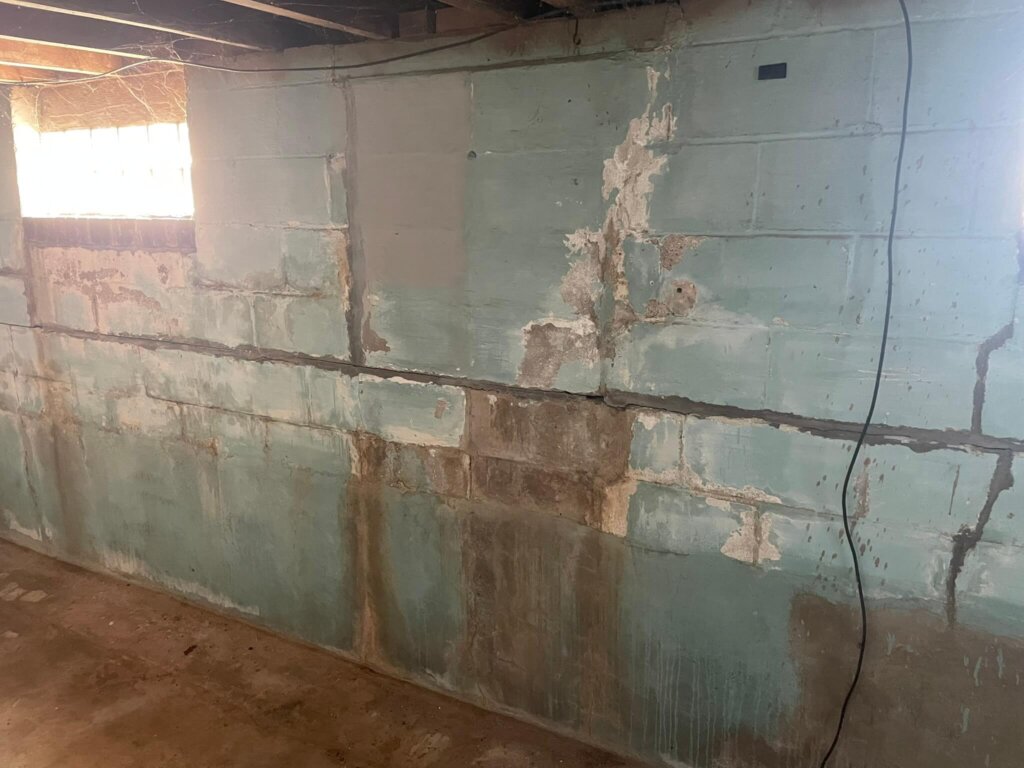
Hydrostatic pressure is the force exerted by water-saturated soil against a foundation wall. In St. Louis’s clay-heavy soil, when significant rainfall saturates the ground near a foundation, the combined weight and pressure of the water-filled soil can exert thousands of pounds per square foot against the foundation wall.
This pressure is the primary driver of bowing walls, horizontal cracking, and eventual wall failure in St. Louis basements. It is also the primary driver of water infiltration through cracks, seams, and floor-wall joints.
The drainage connection: Hydrostatic pressure is dramatically worsened by poor drainage conditions — soil that slopes toward the foundation, gutters that discharge against the house, or downspouts that terminate within five feet of the foundation. Correcting these drainage deficiencies is always part of addressing hydrostatic pressure problems.
Signs of Hydrostatic Pressure
- White chalky deposits (efflorescence) on basement walls: calcium and mineral deposits left behind as water moves through the concrete and evaporates on the interior surface
- Damp or wet walls after rain events
- Horizontal cracking (as described above)
- Inward bowing of wall sections
- Water infiltration at the floor-wall joint (the cove joint)
- Peeling paint on concrete block walls from moisture migration
Settling, Shifting, and Bowing — The Three Major Movement Problems
Differential Settling
What it is: Different portions of the foundation settling at different rates, causing the structure to rack (twist) or the foundation to crack where different settlement rates meet.
Why it happens in St. Louis: Variations in the soil composition under different portions of the foundation, variation in drainage conditions around the perimeter, roots from mature trees drawing moisture from soil under one section of the foundation, or variation in the original soil preparation and compaction under the slab or footings.
The warning signs: Doors and windows that no longer open, close, or latch properly. Visible gaps between door frames and walls. Diagonal cracking from corners of windows and doors. Floors that are visibly sloping or that have developed a perceptible tilt. In severe cases, visible separation between the foundation and the sill plate (the first structural framing member above the foundation).
Repair approach: Differential settling that is ongoing requires addressing the underlying soil condition — either through underpinning (installing piers to transfer the foundation load to stable soil below the settling zone) or through soil stabilization. Settling that has stopped on its own (as evidenced by stable cracks and no new door/window issues) may require only cosmetic repair if the settled position is structurally adequate.
Hydrostatic Bowing
What it is: Inward deflection of a foundation wall under lateral soil pressure.
The industry measurement standard: Foundation contractors and structural engineers measure bowing in inches of deflection from the original wall plane. Industry guidelines suggest:
- Less than 2 inches of deflection: Carbon fiber straps or wall anchor systems are typically viable
- 2 to 4 inches of deflection: Wall anchors combined with staged correction, or steel I-beam support
- Greater than 4 inches of deflection: Wall replacement may be required
The critical rule: A wall that has already moved is not a wall that has stabilized. Any bowing wall that is not actively supported or repaired will continue to move. The question is not whether it will get worse without intervention — it will. The question is how quickly.
Sinking Concrete Slabs
For St. Louis homes with slab foundations or slab areas (garage floors, exterior walkways, patios), the clay soil contraction in dry periods can cause voids to form under the slab, leading to sinking sections. This “slab sinking” is distinct from deep foundation failure — it is the concrete slab losing its sub-base support, not the structural foundation system failing.
Signs: Sections of the slab that have dropped below adjacent sections, creating trip hazards or drainage problems. Hollow sound when the slab is struck in certain areas.
Repair approach: Mudjacking (pumping a slurry mixture under the slab to lift and re-support it) or polyurethane foam injection are the two primary repair methods.
- Mudjacking cost in St. Louis: $3 to $6 per square foot, depending on access and conditions
- Poly foam injection: $5 to $25 per square foot — more expensive but lighter-weight and longer-lasting
The Complete Repair Options and Their Costs
Crack Injection — For Vertical and Isolated Cracks
What it is: Injecting epoxy or polyurethane foam into a crack to seal it against water infiltration and restore some structural continuity.
Epoxy injection: Restores tensile strength across the crack; appropriate for structurally significant cracks in poured concrete walls that are stable (no longer actively moving). Creates a bond stronger than the surrounding concrete.
Polyurethane foam injection: Flexible, water-resistant; appropriate primarily for waterproofing a crack that is not structurally compromised. Better for cracks where some ongoing movement is expected.
Cost: $500 to $2,000 for a typical single-crack injection, depending on the length and access.
What it does NOT do: Injection treats the crack but does not address the cause. If the crack was caused by an ongoing force (hydrostatic pressure, differential settling), the crack can re-open or migrate even after injection. Treating the cause is as important as treating the crack.
Carbon Fiber Straps — For Walls With Moderate Bowing
What they are: High-tensile-strength carbon fiber straps bonded to the interior face of a bowing wall and anchored to the floor and floor joists above, preventing further inward movement.
Best for: Block or poured concrete walls with less than 2 inches of bowing and no significant cracking pattern suggesting imminent failure. Carbon fiber straps are the most commonly recommended solution for early-to-moderate bowing wall conditions in St. Louis.
What they do and do not do: Carbon fiber straps prevent further movement but do not push the wall back to its original position. They arrest the problem; they do not correct it. This is an important distinction when selling a property — a wall that has been stabilized with carbon fiber straps is more defensible than an unstabilized bowing wall, but buyers will observe the straps and understand the history.
Cost: $400 to $600 per strap installed, with typical projects requiring 3 to 6 straps per wall section. Total cost for a 20-foot wall: $1,200 to $3,600.
Timeline: Carbon fiber strap installation is typically a one-to-two-day project. No excavation required. Minimal disruption.
Wall Anchors — For Walls With Moderate to Significant Bowing
What they are: Steel plates anchored to stable soil outside the foundation, connected by a steel rod through the wall to an interior wall plate. The exterior anchor resists outward soil force; the interior plate holds the wall.
The correction capability: Unlike carbon fiber straps, wall anchors can be tightened over time — typically over a period of one to three years — to gradually straighten the wall back toward its original position as the seasonal soil cycle permits.
Cost: $700 to $1,200 per anchor installed, with typical projects requiring 4 to 8 anchors per wall. Total cost for a 20-foot wall: $2,800 to $9,600.
The excavation consideration: Wall anchor installation requires excavating the exterior soil to place the anchor plate. This adds disruption (landscaping disturbance) and is weather-dependent. The correction process requires annual monitoring and tightening appointments for 1 to 3 years.
Steel I-Beam Support — For Walls With Significant Bowing
What it is: Steel I-beams installed vertically against the interior face of a bowing wall, anchored to the floor and the floor framing above, providing significant lateral resistance to prevent further movement.
Best for: Block walls with 2 to 4 inches of bowing, walls with significant horizontal cracking, or situations where the soil conditions make wall anchors impractical.
Cost: $1,200 to $2,500 per I-beam installed. A 30-foot wall might require 5 to 8 beams: $6,000 to $20,000.
The visual impact: Steel I-beams are visible inside the basement and reduce usable floor space adjacent to the wall. For finished basements, their installation requires demolition and reconstruction of the finished wall. This is a significant practical consideration for livable basement spaces.
Underpinning / Piering — For Settling Foundations
What it is: Installing steel piers (push piers or helical piers) beneath the existing footing to transfer the foundation load from unstable surface soil to stable load-bearing soil or bedrock below.
Push piers: Hydraulically driven steel sections pushed through the soil until they reach stable material. Load is transferred through the pier to the stable layer, relieving the foundation of dependence on the unstable soil.
Helical piers: Steel piers with helical plates that are rotated (screwed) into the ground like a large screw until they reach stable soil. More appropriate for areas without consistent bedrock where push pier installation might be inconsistent.
The lifting capability: In optimal soil conditions, underpinning can lift a settled portion of the foundation back toward its original elevation. In Missouri’s variable soil conditions, partial correction is more typical than full correction.
Cost: Push or helical pier installation in St. Louis: $1,200 to $2,500 per pier. A typical settling foundation repair might require 4 to 10 piers: $4,800 to $25,000.
Timeline: A typical pier installation is a 1-to-3-day project per section, though the full scope depends on the number of piers required and the access conditions.
Full Foundation Replacement — The Last Resort
When it is warranted: Stone or brick foundations that have lost structural integrity, block walls with horizontal cracking and bowing beyond 4 inches, or situations where the wall has moved to the point that it cannot be salvaged by any stabilization method.
What it involves: Excavating the entire exterior perimeter, removing the existing foundation wall, installing new concrete footing and poured concrete or block wall, backfilling, and waterproofing. This is a major construction project requiring temporary shoring of the structure above. Get a good local contractor to handle the non foundation issues when repairing your home.
Cost: $20,000 to $80,000+ for full foundation replacement on a typical St. Louis home, depending on the perimeter length, the soil conditions, and the structural complexity of what is being supported above.
Timeline: 2 to 6 weeks for a typical residential foundation replacement, excluding any landscaping restoration or interior repair work.
When to Act Immediately vs. Monitor — The Decision Framework
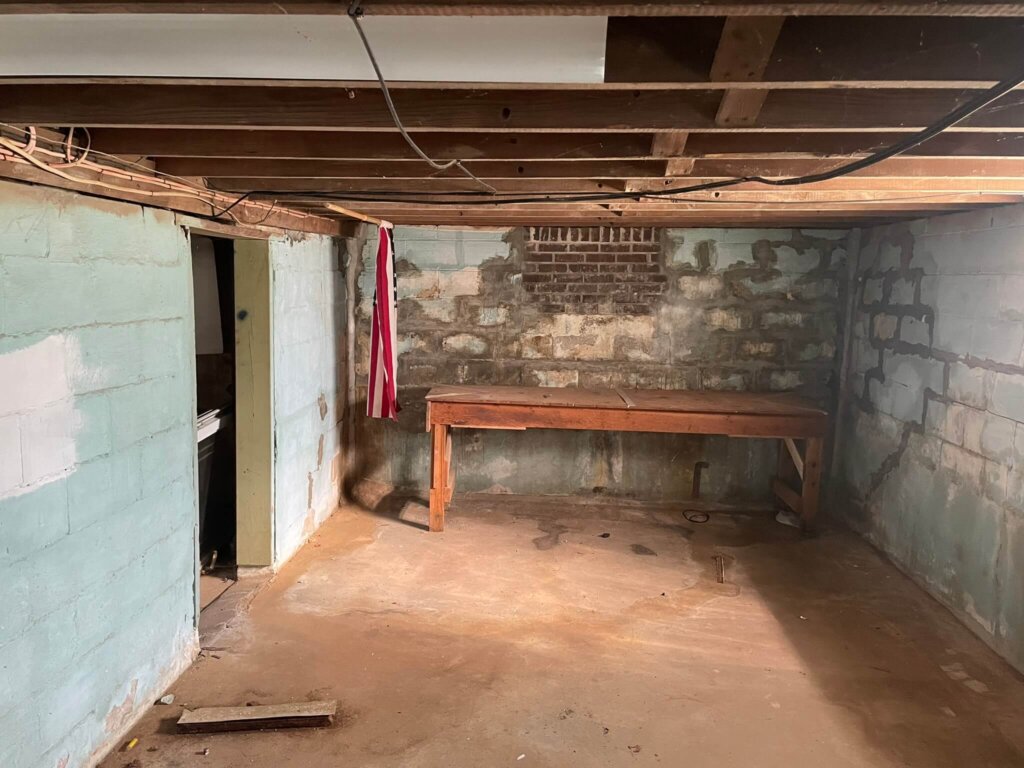
This is the most practically important question for homeowners, and I will give you the direct framework I use when evaluating foundation conditions:
Act Immediately When:
Horizontal cracking in any foundation wall. Do not wait. The force that created the crack is ongoing. Schedule a structural engineer’s evaluation within the week.
Any bowing wall — visible deflection inward of any amount. Bowing walls do not spontaneously improve. Every season of additional moisture cycling adds to the deflection.
Active water infiltration through a crack. Water moving through a crack is eroding the crack path wider and adding to hydrostatic pressure behind the wall. It will get worse every rain event until addressed.
Differential settling with door and window problems appearing for the first time. Newly appearing door and window issues suggest active settling. Evaluate immediately.
Any crack in a stone or brick foundation combined with visible moisture or mortar deterioration. Stone foundations that have mortar failing are losing their cohesion. This is a progressive condition.
Monitor When:
A vertical hairline crack that has been stable, with no displacement and no moisture. Mark the ends with pencil and date. Check every three months for one year. If it does not grow, this is likely a shrinkage crack requiring nothing more than monitoring.
Efflorescence on basement walls with no active water infiltration. Efflorescence indicates past or intermittent moisture movement through the concrete. Improve drainage, monitor for active water.
Minor stair-step cracking in block with tight joints and no displacement. Monitor across seasons. If joints are opening or displacement is developing, escalate.
Differential settling that you believe may have stopped. Document current door and window function, floor levels, and visible crack widths. Re-check in 6 months. Stable conditions can remain monitored; active conditions require action.
Foundation Issues and Home Selling — Your Options
Disclosure Obligations
Missouri’s seller’s disclosure form specifically asks about foundation conditions. A seller who has observed foundation cracks, bowing, settling, or any professional evaluation of the foundation must disclose this history. As discussed in the seller’s disclosure article elsewhere on this site, concealing known foundation conditions is one of the most common sources of post-closing real estate litigation.
The Repair-Before-Listing Decision
For sellers whose foundation conditions are in the moderate range — $3,000 to $15,000 in documented carbon fiber strap or wall anchor repairs — the repair-before-listing decision frequently makes financial sense. A professionally repaired foundation, with a transferable warranty from a licensed contractor, is a more marketable property than one with visible bowing or cracking that buyers and their agents will factor into every offer.
The warranty question: Most professional foundation repair contractors offer transferable warranties — typically 10 to 25 years — that can be passed to the new owner at sale. A transferable warranty on completed foundation work is a genuine selling asset. Get it in writing and confirm the transferability before listing.
Selling As-Is With Foundation Issues
For sellers whose foundation conditions are in the severe range — significant bowing, underpinning needs, or full wall replacement — the cost of repair can approach or exceed the home’s value in some St. Louis markets. A North City or North County home valued at $95,000 with $35,000 in foundation work is not a repair-before-listing candidate.
For these situations, Cash Offer Man purchases properties as-is with full awareness of foundation conditions. We price the repair scope into our offer, accept the risk of what the excavation and repair process will reveal, and close on the seller’s timeline. The seller does not need to manage contractors, navigate the permit process, or worry about what the repair might uncover.
What we look for in a foundation assessment: We evaluate the crack type (horizontal vs. vertical), the displacement, the evidence of active movement versus stable historical conditions, the drainage patterns around the foundation, and the structural engineering implications for the repair approach. We use this assessment to make a fair offer that reflects real repair costs — not inflated contingency padding.
Summary: Foundation Conditions at a Glance
| Condition | Severity | Typical Cost to Repair | Act or Monitor? |
| Hairline vertical crack, stable, no moisture | Low | $0–$500 (sealant) | Monitor |
| Vertical crack >1/4″, with moisture | Moderate | $500–$2,000 (injection) | Act |
| Horizontal crack, any width | High–Emergency | $3,000–$20,000+ | Act immediately |
| Bowing wall <2″ deflection | Moderate-High | $1,200–$4,000 (carbon fiber) | Act |
| Bowing wall 2–4″ deflection | High | $5,000–$20,000 (anchors/I-beams) | Act immediately |
| Bowing wall >4″ deflection | Emergency | $20,000–$80,000+ (replacement) | Emergency action |
| Stair-step crack, tight, stable | Low-Moderate | $500–$3,000 (repointing) | Monitor |
| Stair-step crack, opening, displacement | Moderate-High | $5,000–$25,000 (piering) | Act |
| Differential settling, active | Moderate-High | $5,000–$25,000 (underpinning) | Act |
| Stone/brick mortar deterioration | Moderate | $2,000–$15,000 (repointing) | Act |
| Full wall failure/replacement needed | Emergency | $20,000–$80,000+ | Emergency |
| Structural engineer evaluation | N/A | $200–$600 | Always first step |
Aaron Eller is the founder of Cash Offer Man, a local home buying company serving St. Louis City, St. Louis County, and surrounding Missouri communities. Cash Offer Man purchases homes with foundation issues of any severity for cash, with closings in as little as 14 days — no repair required. Visit CashOfferMan.com for a no-obligation offer.
Get An Offer Today, Sell In A Matter Of Days