
The Best Things to Do in St. Louis: A Local’s Complete Guide
By Aaron Eller, Founder — Cash Offer Man | St. Louis, Missouri
April 18, 2026
People who have never been to St. Louis often underestimate it. They picture it as a flyover city, a place you pass through on the way somewhere else, defined by its most difficult headlines and its faded industrial past. Then they actually come here — or, better yet, they live here — and they discover something entirely different.
St. Louis is one of the most quietly extraordinary cities in America. It has world-class museums that charge no admission. It has a history that shaped the entire American West. It has a baseball culture that rivals any in the country, a food scene that has developed a genuine national reputation, and more free public parkland and green space per capita than almost any city on earth. It has neighborhoods with architectural character that make visitors from coastal cities stop and stare. And it has the kind of stubborn, self-deprecating pride that Midwestern cities wear like armor — a community that knows exactly what it has, even when the rest of the country has not caught up yet.
I am Aaron Eller, the founder of Cash Offer Man. I was born here. I have built my business here. I drive these streets every week, in every neighborhood, in every part of this city and its surrounding communities. I know where to take people who have never been to St. Louis and watch their faces change when they understand what this city actually is.
This is my guide to St. Louis — the institutions that have defined it for generations, the new energy that is reshaping it, the things we have lost, and the things that are coming. Let’s start at the most iconic address in the city.
The Gateway Arch and the Jefferson National Expansion Memorial
Location: Downtown St. Louis riverfront, along the Mississippi River. Gateway Arch National Park, 11 N. 4th Street, St. Louis, MO 63102. Admission: Tram ride to top: $15 adults, $10 ages 3–15. Museum: $10 adults, $5 ages 3–15. The grounds are free. Best time to go: Weekday mornings in spring or fall for the shortest tram lines. Sunset from the riverfront is spectacular year-round.
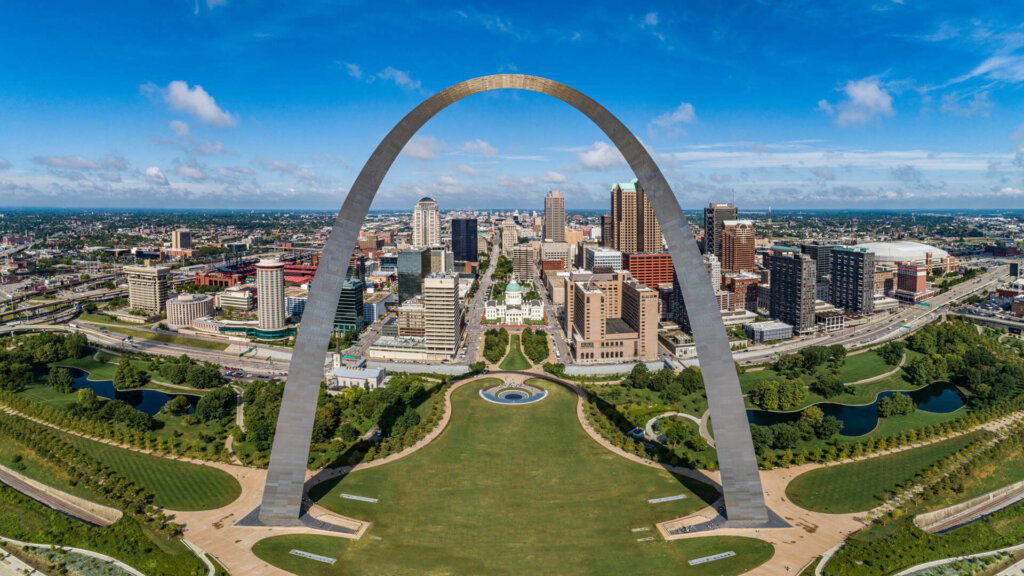
No conversation about St. Louis begins anywhere except here. The Gateway Arch is the tallest monument in the United States — 630 feet of stainless steel standing in a perfect catenary curve on the west bank of the Mississippi River — and it is, by any measure, one of the most extraordinary pieces of architecture and engineering on the continent.
Eero Saarinen, the Finnish-American architect who won the 1947 design competition for the Jefferson National Expansion Memorial, created something that should not be possible. The Arch has no right angles. Its two legs meet at exactly the right point at the top despite being constructed simultaneously from opposite ends. The engineering required to build it — in 1963 through 1965, using a system of creeper cranes that crawled up the interior as the structure rose — was genuinely unprecedented. When the final keystone section was fitted on October 28, 1965, the two legs had to be hydraulically expanded by an inch to close the gap. They fit together within a fraction of an inch of the design specification.
The tram ride to the top is an experience unique in American tourism. The capsules that carry five people each are egg-shaped contraptions that rotate to stay level as they travel along the curved interior of the legs. The ride takes four minutes in each direction, during which you feel like you are inside some strange mechanical creature. At the top, small windows on both sides look out over the Mississippi and the St. Louis skyline, and on a clear day you can see 30 miles in each direction.
The Museum at the Gateway Arch, which was completely renovated and reopened in 2018, tells the story of American westward expansion with genuine depth and complexity — including the difficult truths about what that expansion meant for the Native peoples who were displaced. It is among the best history museums I have visited anywhere.
What makes the Arch even more remarkable is what surrounds it. The museum renovation opened up the grounds significantly, creating a more welcoming park environment on the riverfront that had been somewhat inaccessible before. The connection between the park and downtown St. Louis — through tunnels under the highway and improved pedestrian connections — has made the Arch genuinely walkable from downtown hotels and restaurants in a way it was not for decades.
Busch Stadium and St. Louis Cardinals Baseball
Location: 700 Clark Avenue, downtown St. Louis. One block south of the Arch grounds. Tickets: Range from $15 for outfield bleachers to $200+ for premium seats. Average ticket around $35–$55. Best time to go: The Cardinals have among the most loyal fan bases in baseball — every game has energy. Opening Day (April) and playoff races (September) are electric. Summer weeknights are my personal favorite.
The St. Louis Cardinals are not just a baseball team. They are a civic institution. This is the franchise that has won 11 World Series championships — second only to the New York Yankees in baseball history — and the people of St. Louis have repaid that history with a loyalty that is unique in professional sports. The Cardinals regularly rank among the top five teams in Major League Baseball in attendance despite playing in a metropolitan area smaller than most of their competitors. In some seasons, they lead the entire league.
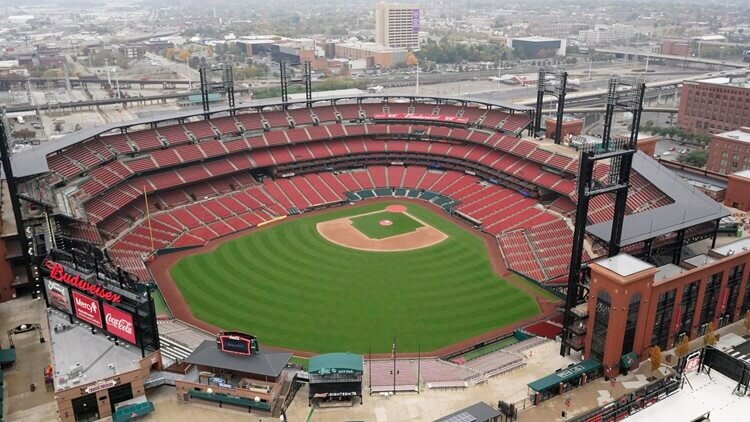
Busch Stadium, the current iteration of which opened in 2006, is widely regarded as one of the finest ballparks in the country. It was designed specifically to take advantage of the Arch as a backdrop — you can see the Gateway Arch over the right field wall from almost any seat in the stadium, a view that stops people who are seeing it for the first time mid-sentence. The open concourse design means you can walk the entire circumference of the stadium without losing sight of the game, the food options have genuinely improved to the point where multiple national food publications have ranked Busch Stadium among the best stadium food experiences in baseball, and the neighborhood around it — Ballpark Village — has developed into a genuine entertainment district.
The Cardinals have been a St. Louis institution since 1882, making them one of the oldest continuous franchises in American professional sports. They have called three versions of Busch Stadium home (the original Sportsman’s Park on the North Side became the first Busch Stadium; the second circular concrete Busch opened in 1966; the current stadium opened in 2006 when the old one was demolished). Stan Musial, Bob Gibson, Lou Brock, Ozzie Smith, Albert Pujols, Yadier Molina — the Cardinals have produced more Hall of Famers than almost any franchise, and their names are spoken in St. Louis with the same reverence that New Yorkers reserve for DiMaggio and Gehrig.
If you are visiting St. Louis between April and October, going to a Cardinals game at Busch Stadium is not optional. It is mandatory.
Forest Park: The Greatest Urban Park in America
Location: Between Kingshighway Boulevard (east), Skinker Boulevard (west), Oakland Avenue (south), and Lindell Boulevard (north). Central St. Louis. Admission: The park itself is free. Individual attractions vary. Best time to go: Year-round. Spring and fall are peak beauty. Summer evenings for events. January for peaceful solitude.
Forest Park was built for the 1904 World’s Fair — the Louisiana Purchase Exposition — which drew 19 million visitors over seven months and introduced the world to the ice cream cone, the hot dog on a bun, iced tea, and Dr Pepper. The fair’s fairgrounds covered 1,272 acres along what was then the western edge of St. Louis, and the scale of what was constructed here was genuinely breathtaking. Twelve nations sent official representation. The Palace of Fine Arts — which survives today as the St. Louis Art Museum — was the only permanent structure built for the fair.
Today, Forest Park spans 1,371 acres — 500 acres larger than Central Park in New York City — and within those acres sits a collection of free cultural institutions that is essentially unmatched anywhere in America.
The St. Louis Art Museum
Location: One Fine Arts Drive, within Forest Park. Free.
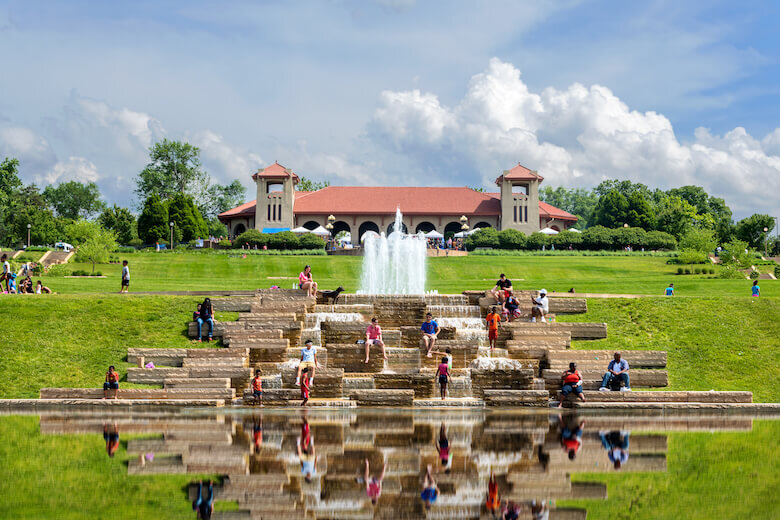
The SLAM (as it is known locally) occupies the original Palace of Fine Arts building from the 1904 World’s Fair, perched on Art Hill with a view down to the Grand Basin below. The permanent collection of more than 34,000 works spans 5,000 years of art history, with particular strength in pre-Columbian art, German Expressionism, and American art. The permanent collection is entirely free — you pay only for special traveling exhibitions. It is, by any measure, a world-class art museum in a setting that rivals any museum campus in the country.
Art Hill itself is one of the great gathering places in St. Louis. In summer, the Grand Staircase and the lawn below attract families, cyclists, and picnickers. In winter, when there is snow, Art Hill becomes the best urban sledding hill in Missouri, and the sight of hundreds of families with sleds descending the hill below the museum is one of the most characteristically St. Louis scenes imaginable.
The Saint Louis Zoo
Location: 1 Government Drive, within Forest Park. Free general admission.
The Saint Louis Zoo is consistently ranked among the top zoos in the United States, and it is entirely free. No other major American zoo offers free general admission at the scale and quality that St. Louis offers. The zoo covers 90 acres and is home to more than 16,000 animals representing nearly 700 species. The River’s Edge, the Big Cat Country, the Penguin & Puffin Coast — these are exhibits that would cost $40 a head to enter at any comparable institution in the country.
The zoo traces its origin to the 1904 World’s Fair, which left behind a collection of animals from the international exhibits. The Missouri Legislature created the Metropolitan Zoological Park and Museum District in 1971, which established the tax-based funding model that allows the zoo to remain free. This is one of the genuinely great civic achievements in St. Louis history — a decision made 50 years ago that continues to deliver joy to millions of visitors every year.
The Missouri History Museum
Location: Lindell Boulevard at DeBaliviere Avenue, Forest Park. Free.
The Missouri History Museum is perhaps the best regional history museum I have encountered anywhere in America. Its permanent collection covers the full arc of St. Louis and Missouri history — from Indigenous peoples through French settlement, the Louisiana Purchase, westward expansion, the Civil War, the Great Migration, and into the present. The 1904 World’s Fair exhibit is particularly extraordinary, with artifacts and immersive recreations that make that pivotal moment in St. Louis history tangible.
The building itself — a Jefferson Memorial Hall completed in 1913 — is spectacular, with its marble rotunda and heroic scale. The museum has been significantly expanded over the decades while preserving the original architecture.
The Muny
Location: 1 Theatre Drive, within Forest Park. Tickets from $15 to $100+; first two rows of each section are always free.
The Muny — officially the Municipal Theatre — is the oldest and largest outdoor musical theater in America, seating 11,000 people in a natural amphitheater within Forest Park. It opened in 1919, and for more than a century it has been staging Broadway-caliber productions under the open sky every summer, June through August.
What makes the Muny unique is not just its scale and age. It is the St. Louis institution that cuts across every demographic and neighborhood — the place where grandparents bring grandchildren and teenagers come on dates and families spread out on the lawn. The 1,500 free seats at the back of the house have been a St. Louis tradition for generations, allowing anyone to experience professional theater regardless of income. Productions typically run the gamut from classic Rodgers and Hammerstein to contemporary Broadway.
On a warm June night, sitting in the open air at the Muny as the sun sets over Forest Park, watching a professional production with 10,000 of your neighbors — that is quintessential St. Louis.
The Missouri Botanical Garden (Shaw’s Garden)
Location: 4344 Shaw Boulevard, St. Louis, MO 63110. Tower Grove South neighborhood. Admission: $16 adults, $8 children ages 3–12. Members free. Best time to go: Late April through October. The Japanese Garden is stunning in fall. Christmas Garden in December is magical.
Henry Shaw was an Englishman who came to St. Louis in 1819 as a merchant, made a fortune, and devoted the second half of his long life to the creation of a botanical garden that would rival the great gardens of Europe. When the Missouri Botanical Garden opened in 1859, it was one of the first public botanical gardens in the United States.
Today, 165 years after Shaw opened the gates, the Missouri Botanical Garden is ranked among the top five botanical gardens in the world. Its 79 acres contain more than 6,000 plant species, the largest climate-controlled geodesic dome greenhouse in the Western Hemisphere (the Climatron), and the largest traditional Japanese garden in North America (the Seiwa-en, covering more than four acres). The research mission of the garden — it employs more than 250 scientists and maintains a herbarium of 6.6 million specimens — makes it one of the leading centers for plant science on earth.
St. Louis people call it “Shaw’s Garden,” honoring the founder’s name in a way that has persisted for 165 years. The neighborhood that surrounds it is called Shaw. This is how deeply embedded this institution is in the fabric of the city.
The garden hosts major events throughout the year — the Japanese Festival on Labor Day weekend, a Chinese culture festival, Garden Glow at Christmas with more than a million lights — that draw visitors from across the region and the country. But on any Tuesday morning in October when the trees are turning and the chrysanthemums are blooming, it is simply one of the most beautiful places in Missouri.
Anheuser-Busch Brewery
Location: 12th and Lynch Streets, St. Louis, MO 63118. Soulard neighborhood, South City. Tours: Free tours available, with paid premium options. Tours run daily. Best time to go: Weekday tours are less crowded. The Clydesdale horses are a perennial crowd favorite.
The Anheuser-Busch Brewery complex in the Soulard neighborhood is more than a factory. It is a living museum of 19th-century industrial architecture, a historic landmark, and one of the most recognizable brand origins in American commercial history.
Eberhard Anheuser purchased a struggling brewery in 1860. His son-in-law, Adolphus Busch — who is widely credited with creating the modern American brewing industry — transformed the company into a national brand through refrigerated rail cars (which allowed beer to be shipped long distances without spoiling), pasteurization technology, and marketing genius. Budweiser, introduced in 1876, became the best-selling beer in America and eventually the world.
The brewery campus in Soulard — spanning 142 acres and including buildings that date to the 1860s and 1870s — is a National Historic Landmark. The Clydesdale stables, the red brick lagering cellars built into the hillside, the copper brewhouse dating to 1892 — these are among the most historically significant commercial buildings in the American Midwest.
The 2008 acquisition of Anheuser-Busch by the Belgian company InBev for $52 billion was a profound civic shock in St. Louis. The company that had been synonymous with the city for 150 years was no longer headquartered here in the same way, no longer controlled by the family that had shaped the institution. The local ownership, the Busch family’s civic engagement, and the sense that the brewery was a St. Louis institution first and a global corporation second all changed with that acquisition. The brewery still operates; the tours are still excellent; the Clydesdales are still magnificent. But the relationship between the company and the city has never quite been the same.
Six Flags St. Louis
Location: I-44 at Six Flags Road, Eureka, MO 63025. Approximately 30 miles southwest of downtown St. Louis. Admission: Single-day tickets approximately $45–$80 depending on timing. Season passes available. Best time to go: Weekdays in June and early September for shortest wait times. Hurricane Harbor water park adjacent for hot summer days.
Six Flags St. Louis opened in 1971, and for millions of St. Louisans it represents something almost totemic about growing up here. The Screamin’ Eagle — a wooden coaster that opened in 1976 and was once the fastest wooden roller coaster in the world — has carried generations of St. Louisans through their first roller coaster terror. The park sits in a beautiful Ozark hills setting that gives it a natural character distinct from the flat-terrain parks that dominate amusement industry geography.
The park has gone through significant changes over its five decades — rides added, rides removed, ownership changes, the addition of Hurricane Harbor water park — but it remains the dominant regional amusement park for St. Louis and has a loyal fanbase that includes multi-generational family attendance.
St. Charles Main Street: Where St. Louis History Began
Location: Main Street, St. Charles, MO 63301. Approximately 25 miles northwest of downtown St. Louis, just across the Missouri River. Admission: Free to explore. Individual restaurant and shop prices vary. Best time to go: Year-round, but the Christmas season on Main Street is particularly spectacular. First Missouri State Capitol historic site is free.
Most people outside Missouri do not realize that St. Charles, not Jefferson City, was Missouri’s first state capital. And Main Street in St. Charles — a meticulously preserved stretch of 19th-century commercial and residential architecture running along the Missouri River — is among the finest historic streetscapes in the Midwest.
Lewis and Clark set out from Camp Dubois, just across the river in Illinois, on May 14, 1804, but they stopped first in St. Charles, where they took on additional crew and supplies before heading upriver into the unknown. The city existed as a French colonial settlement by 1769, making it one of the oldest European settlements west of the Mississippi River.
Today, Main Street is a thriving destination with independent restaurants, antique shops, wine bars, boutiques, and bed-and-breakfasts occupying buildings that have stood for 150 to 200 years. The First Missouri State Capitol State Historic Site preserves the actual rooms where Missouri’s first legislature met from 1821 to 1826. Walking Main Street in St. Charles feels genuinely different from any manufactured “historic district” — because it is genuinely historic, and because the community has invested in preserving its character for decades.
The Christmas season transforms Main Street into one of Missouri’s most popular holiday destinations, with the streets illuminated, carolers in Victorian dress, and the storefronts decorated in period style. Tens of thousands of visitors come from across the St. Louis metro for the Christmas Traditions event on Main Street each November and December.
The St. Louis Blues: Hockey in a Hockey Town
Location: Enterprise Center, 1401 Clark Avenue, downtown St. Louis (across from Busch Stadium). Tickets: Range from $35 for upper bowl to $300+ for premium seats. Best time to go: Playoff atmosphere is unlike anything in sports. Regular season games against Chicago and Detroit are reliable rivalries.
The Blues were founded in 1967 as one of the original six expansion franchises of the modern NHL era, and for 52 years they were defined by a franchise-wide near-miss: the most playoff appearances of any team without a Stanley Cup championship. They went to the Cup Finals in each of their first three seasons (1968, 1969, 1970) and lost all three. Decades of playoff runs ending in disappointment became part of the city’s identity — “same old Blues,” as the expression went.
Then 2019 happened.
On June 12, 2019, the St. Louis Blues won the Stanley Cup for the first time in franchise history, completing a comeback from last place in the entire NHL in January to champions in June. It was the most dramatic sporting story in St. Louis in decades, and the celebration — downtown packed with hundreds of thousands of fans, a championship parade that shut down the entire city — matched the magnitude of the wait.
The city has not been the same since. The Blues have been selling out Enterprise Center consistently in the years following the championship, and the team’s connection to “Gloria” — the Gloria Gaynor song that became the rallying anthem during the 2019 run — gives every home game an emotional resonance that is impossible to explain to people who did not live through it.
The Enterprise Center itself was renovated and renamed (formerly Kiel Center, then Savvis Center, then Scottrade Center) through the years and sits in the heart of downtown St. Louis near Busch Stadium, creating a genuine sports and entertainment district that draws hundreds of thousands of visitors per year.
Things We Have Lost: The Ram, Downtown’s Struggles, and What Changed
St. Louis is a city that wears its losses alongside its pride, and an honest guide to this city requires acknowledging what is gone.
The Rams
The St. Louis Rams played in the Edward Jones Dome (now Dome at America’s Center) from 1995 through 2015, and for a period in the late 1990s and early 2000s, they were the greatest show in professional football. The “Greatest Show on Turf” Rams — Kurt Warner, Marshall Faulk, Isaac Bruce, Torry Holt, Dick Vermeil coaching — won Super Bowl XXXIV on January 30, 2000, and became one of the most celebrated offenses in NFL history.
The 2000 Super Bowl champions played at the highest level in recent memory. I watched those games with my family, with neighbors, at bars on Chippewa Street. There was something about that team — the way Warner came from stocking groceries at a Casey’s General Store to Super Bowl MVP, the way Faulk was unstoppable in a way that was almost unfair, the way the city embraced them — that made the eventual departure in 2016 feel like a genuine civic wound.
Owner Stan Kroenke’s decision to relocate the Rams to Los Angeles was widely viewed as an act of bad faith toward a fan base that had consistently supported the team even through terrible seasons. The lawsuit the city filed against the NFL, and the eventual $790 million settlement that St. Louis received in 2023, validated much of what fans had felt about the relocation process. But the settlement did not bring the team back, and St. Louis remains one of the largest markets in America without an NFL franchise. Whether a future NFL team comes to St. Louis — discussion continues about a potential new stadium — remains the most watched civic sports story in the region.
Downtown’s Challenges
Anyone who has spent time in downtown St. Louis over the past decade has watched the challenges accumulate. Several major retailers, restaurants, and entertainment venues that once anchored the downtown experience have closed. The Railway Exchange Building, which housed the Famous-Barr department store for generations, has been vacant since 2014. The AT&T Tower, once the city’s most prominent corporate address, has been vacant since 2017. Property crime — particularly car break-ins and smash-and-grabs — has driven away some businesses and deterred some visitors.
The honest assessment is that downtown St. Louis is in a period of difficult transition. The forces reshaping it — the shift from retail to experiential entertainment, the pandemic’s lasting effects on office occupancy, the challenges of managing a dense urban environment with limited resources — are not unique to St. Louis. But St. Louis’s specific geography (a relatively small downtown surrounded by an unusual number of independent municipalities) and its decades-long population decline create structural challenges that are genuinely harder than what many comparable cities face.
At the same time, there are real reasons for optimism about downtown. CityPark stadium — home of St. Louis City SC, the Major League Soccer expansion franchise that began play in 2023 — has been a genuine catalyst for the area north of downtown, creating a new entertainment node and attracting development that did not exist three years ago. The Blues and Cardinals continue to draw enormous numbers of visitors downtown. And the office-to-residential conversion projects underway across downtown — converting vacant office towers into apartments — represent a realistic and potentially transformative path forward for the urban core.
What’s Coming: Chesterfield’s Massive Development
If you want to understand where a significant piece of St. Louis’s future energy is being built, drive west on I-64 to Chesterfield — specifically to the former Chesterfield Mall site on Chesterfield Airport Road.
Chesterfield Mall opened in 1976 as one of the dominant regional shopping destinations in the St. Louis metro, anchored by Famous-Barr, Sears, Dillard’s, and J.C. Penney. For 30 years it was the kind of place that defined suburban commercial life — packed on weekends, the gathering place for teenagers and families across West County.
The mall began its long decline in the 2000s as the retail landscape shifted and anchor stores closed. By the late 2010s, it was a shadow of its former self, with long stretches of vacant storefronts and the particular sadness of a dead mall in an era that no longer has much use for them.
The redevelopment of the Chesterfield Mall site is one of the most significant commercial real estate projects in the St. Louis region in a generation. The planned mixed-use development — which goes by several names in various planning documents but is being built out as a genuine lifestyle district — envisions replacing the enclosed mall with an outdoor Main Street-style development combining retail, restaurants, residential units, office space, hotel space, and entertainment venues.
The scale of what is being proposed for the former mall site is genuinely ambitious. Chesterfield’s location — at the intersection of I-64 and Missouri Route 340, with excellent highway access from across the St. Louis metro — gives it a catchment area that could make it the dominant West County entertainment and lifestyle destination. The city of Chesterfield has invested in infrastructure to support the development. Early phases of construction are underway.
What this development represents, in the broader context of St. Louis’s evolution, is an acknowledgment that the enclosed regional mall model is done — and an attempt to replace it with something that matches how people actually want to spend their time in 2026. Whether it delivers on its full ambition will depend on execution, timing, and whether St. Louis consumers embrace the outdoor district format the way they have embraced similar developments in other Midwestern cities. But it is the most watched commercial real estate story in the region.
The City Museum
Location: 750 N. 16th Street, St. Louis, MO 63103. Downtown St. Louis. Admission: $20 adults, $16 children ages 3–12. The rooftop opens seasonally. Best time to go: Weekday evenings to avoid peak crowds. Rooftop is best in good weather.
If you visit only one thing in St. Louis that will completely upend your expectations, visit the City Museum. It defies every category. It is not a traditional museum. It is not an amusement park. It is not a sculpture. It is all of these things simultaneously, in a way that no other institution anywhere in America replicates.
Artist Bob Cassilly began transforming a 10-story former shoe factory in downtown St. Louis in the late 1990s, and what emerged over more than a decade of continuous construction is one of the most extraordinary built environments on the continent. Enormous slides descend through the building and outside. Tunnels wind through the walls and ceilings. A pair of salvaged airplanes emerge from the facade. A ten-story slide. A rooftop Ferris wheel. A shoelace factory cave. Caves, grottos, ball pits, circus trapeze, and architectural salvage from across St. Louis — gargoyles, bank facades, ironwork, stone pillars — incorporated into an environment that rewards exploration for hours.
Cassilly died in 2011 before completing his vision, but the City Museum continues to evolve under its current ownership. It is one of the genuinely unique things in the world — not in St. Louis, not in the Midwest, in the world — and it has become a destination that brings visitors to St. Louis specifically to experience it.
The Soulard Neighborhood and Farmers Market
Location: Soulard neighborhood, South City. Farmers Market at Carroll Street and 7th Street. Farmers Market Admission: Free. Open Wednesday through Sunday. Best time to go: Saturday mornings for the full farmers market experience. Mardi Gras season (February) for the largest Mardi Gras celebration outside New Orleans.
The Soulard neighborhood is the oldest continuously inhabited neighborhood in St. Louis, with French colonial roots that date to the late 18th century. Antoine Soulard, a French surveyor, left his name to the community, and the architectural character of the neighborhood — brick rowhouses, flounder houses with their distinctive half-roofs, narrow lots pressing right to the sidewalk — reflects that French urban tradition in ways that are visible and tactile.
The Soulard Farmers Market has been operating on the same site since 1779 — before the United States was a country — making it the oldest public market west of the Mississippi River. On a Saturday morning, the market is one of the most lively public spaces in the city: vendors selling fresh produce, meat, flowers, prepared foods, and crafts from covered stalls that fill the historic market building and spill into the adjacent streets.
Soulard Mardi Gras, held annually in the weeks leading up to Fat Tuesday, is the second-largest Mardi Gras celebration in the United States. The neighborhood’s bars, restaurants, and streets become the venue for a weeks-long festival that draws hundreds of thousands of participants and gives Soulard’s already-festive social scene an additional layer of concentrated joy.
The Delmar Loop and University City
Location: Delmar Boulevard between Skinker and Limit Avenues, University City, MO. Admission: Free to walk. Individual restaurant and shop prices vary. Best time to go: Year-round. Friday and Saturday evenings for the full dining and nightlife scene.
Rolling Stone magazine once named the Delmar Loop one of the Greatest Streets in America, and anyone who has spent time there understands why. The Loop is a stretch of independent restaurants, music venues, boutiques, coffee shops, and cultural institutions that is genuinely unlike any suburban commercial strip in the country.
The Tivoli Theatre, one of the oldest operating movie theaters in Missouri, shows art house and independent films. Blueberry Hill — the restaurant/music club founded by Joe Edwards, who is largely responsible for the Loop’s renaissance — houses the largest jukebox museum I have encountered and has a basement music venue that has hosted major touring acts since the 1970s. Chuck Berry, who grew up in the nearby Ville neighborhood of North City, performed his legendary monthly residency at Blueberry Hill for years.
The St. Louis Walk of Fame — brass stars set into the sidewalk honoring St. Louisans who have achieved national distinction — runs along the Loop and includes names from T.S. Eliot to Tina Turner to Yogi Berra. Walking the Loop means walking past the embedded stars of people who changed American culture.
Ted Drewes Frozen Custard
Location: 6726 Chippewa Street, St. Louis, MO 63109 (South City). Seasonal second location on Gravois. Admission: Free. Concretes approximately $4–$8. Best time to go: Summer evenings. The line is always worth it.
Ted Drewes is not just a custard stand. It is one of the most beloved food institutions in a city that takes its food institutions very seriously. Since Ted Drewes Sr. opened the original stand in the 1920s, the family business has served generations of St. Louisans from the same spot on Chippewa Street — a Route 66 landmark that has never moved, never franchised, and never changed what it is.
The “concrete” — a frozen custard dessert so thick it is served upside down without spilling — was invented here. The seasonal menu rotates, but the classics (the “All Shook Up,” the “Fox Treat,” the “Cardinal Sin”) have been defining summer in St. Louis for decades. On a hot July night, the line at Ted Drewes wraps down the sidewalk and people wait 20 minutes happily because there is nowhere else in the world you can get what Ted Drewes makes.
Imo’s Pizza, Toasted Ravioli, and St. Louis Food Culture
If there are two things St. Louisans will argue about with people from anywhere else, one is whether Provel cheese — the processed cheese blend unique to St. Louis — belongs on a pizza. (It does.) The other is whether toasted ravioli is an acceptable bar food. (It absolutely is.)
Imo’s Pizza is the dominant regional pizza chain, serving St. Louis-style pizza: thin cracker crust cut into squares, smothered in Provel, and baked until the edges are crispy. It is exactly what it sounds like, and either you love it immediately or you need a few attempts to understand it. I have never met a native St. Louisan who does not have a genuine emotional attachment to Imo’s.
Toasted ravioli — breaded, deep-fried pasta pillows filled with meat or cheese, served with marinara sauce — was invented in the Hill neighborhood of South City, the Italian-American community that remains the heart of St. Louis Italian food culture. Charlie Gitto’s, Cunetto’s House of Pasta, Lorenzo’s Trattoria, and Anthonino’s on The Hill are all landmarks of a neighborhood that takes its culinary heritage with extraordinary seriousness.
Looking Ahead: St. Louis City SC and What’s Next
The 2023 launch of St. Louis City SC — Major League Soccer’s latest expansion franchise — represented something genuinely new for St. Louis: a major league sports franchise built from the ground up with modern ownership, a state-of-the-art stadium, and an explicit mission to serve as a catalyst for urban development.
CityPark stadium, opened in 2023 on the north side of downtown, seats approximately 22,500 fans in a soccer-specific facility designed with the kind of intimate atmosphere that makes European football so compelling. The team immediately sold out its stadium, generating a fan culture that surprised even optimistic observers. The owner group’s commitment to keeping the team locally owned, their investment in youth soccer infrastructure throughout the city and county, and the stadium’s placement in a part of downtown that needed commercial investment have made St. Louis City SC one of the most discussed expansion teams in MLS history.
Whether City SC wins championships or struggles in MLS will determine the shape of this story going forward. But the appetite St. Louis showed for a new major league franchise — the speed with which season tickets sold, the energy of the supporter culture — reflects something real about this city’s hunger for the kind of civic pride that professional sports can deliver.
A Note on Why I Write About This
I run Cash Offer Man, a home buying company. My daily work is purchasing and renovating properties across St. Louis and St. Louis County. I drive through the neighborhoods this city is built from — through North City and South City, through the inner-ring suburbs and the outer communities, through places that are thriving and places that are struggling.
Every article I write about this city — about its history, its institutions, its challenges, its attractions — comes from the same place: genuine love for a city that I believe in more than most people give it credit for. When I take someone to see the Arch for the first time and watch them look up at it and understand for the first time what they are looking at — when I take someone to a Cardinals game and they feel what baseball feels like when a whole city cares about it — when I see the faces of a family who just bought a renovated home in a neighborhood they thought they could not afford — that is St. Louis delivering on what it has always promised.
This city is worth understanding. It is worth visiting. It is worth living in. And for those of us who do live here — who build businesses here, who raise families here, who invest in properties here — it is worth fighting for.
Quick Reference Guide
| Attraction | Location | Cost | Best Season |
| Gateway Arch | Downtown Riverfront | $10–$15 tram | Year-round; spring/fall for lines |
| Busch Stadium / Cardinals | Downtown | $15–$200+ | April–October |
| Forest Park | Central St. Louis | Free | Year-round |
| St. Louis Zoo | Forest Park | Free | Year-round |
| St. Louis Art Museum | Forest Park | Free (perm.) | Year-round |
| The Muny | Forest Park | Free–$100 | June–August |
| Missouri Botanical Garden | Tower Grove South | $16 adults | April–October |
| Anheuser-Busch Brewery | Soulard | Free | Year-round |
| Six Flags St. Louis | Eureka, I-44 | $45–$80 | May–September |
| City Museum | Downtown | $20 | Year-round |
| Soulard Farmers Market | Soulard | Free | Year-round; Sat. mornings |
| Delmar Loop | University City | Free (walking) | Year-round |
| Ted Drewes | Chippewa, South City | $4–$8 | May–October |
| St. Charles Main Street | St. Charles | Free | Year-round; Christmas season |
| Enterprise Center / Blues | Downtown | $35–$300+ | October–April |
Aaron Eller is the founder of Cash Offer Man, a local home buying company serving St. Louis City, St. Louis County, and surrounding Missouri communities. Cash Offer Man purchases homes for cash in any condition, with closings in as little as 14 days. For more information about buying or selling a home in St. Louis, visit CashOfferMan.com. Vist Our Company to learn more about us.
Get An Offer Today, Sell In A Matter Of Days