

St. Louis Tornado Destroyed Homes: What Happened, Who Responded, and What Comes Next
By Aaron Eller, Founder — Cash Offer Man | St. Louis, Missouri
At 2:41 in the afternoon on Friday, May 16, 2025, a tornado touched down near Clayton, Missouri. Over the next several minutes, it crossed the city-county line, grew to nearly a mile wide, reached peak winds of 152 miles per hour, and cut a 22.6-mile path of destruction northeast through the heart of St. Louis City and into Granite City and Edwardsville, Illinois.
By the time it lifted, five people were dead. At least 39 were injured. More than 5,000 structures were damaged or destroyed. Estimated property damage topped $1.6 billion — among the highest figures ever recorded for a single tornado in American history. FEMA officials, upon arriving to assess the damage, called the residential destruction the largest-scale they had surveyed since the 2011 Joplin tornado.
The sirens, in much of the hardest-hit area, never sounded.
I am Aaron Eller, founder of Cash Offer Man, a local home buying company here in St. Louis. I have driven through every neighborhoofd this tornado touched, both in the days immediately after it struck and in the months since. I have talked to homeowners who lost everything and to families still living in damaged homes without roofs eight months later. I have bought tornado-damaged properties and worked through the recovery process firsthand. What happened on May 16, 2025, was not just a weather event. It was a disaster that landed with devastating precision on the most vulnerable communities in this city — and the response from every level of government and industry has been, at best, incomplete.
This is what happened. This is what it looked like. And this is what the future of these neighborhoods may hold.
The Storm: What Happened on May 16, 2025
The National Weather Service had issued a moderate risk of severe weather for the St. Louis area that Friday, the kind of forecast that is not unusual in the spring in Missouri. What developed was something far beyond the ordinary. A rotating supercell thunderstorm intensified rapidly over the western suburbs, and the tornado that dropped from it near Clayton was unlike anything St. Louis had seen in 66 years — since an F4 tornado killed 21 people in 1959.
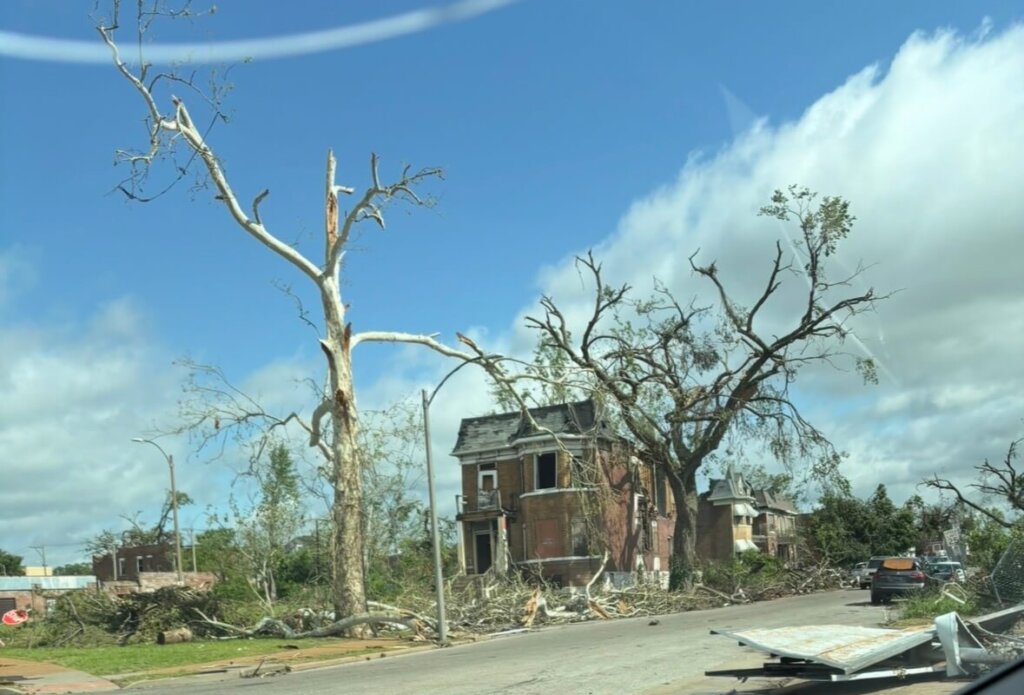
The tornado began at EF1 intensity in Clayton, damaging apartment buildings, snapping trees on the Fontbonne University campus, and cutting a path of damage through the Central West End. As it crossed into St. Louis City, it grew. By the time it reached the DeBaliviere Place neighborhood, it had reached EF2 intensity, heavily damaging multiple apartment buildings, blowing out windows and partially removing roofs. It clipped the north end of Forest Park, disrupting MetroLink’s overhead power systems between stations.
Then it turned north and intensified.
Entering the Fountain Park neighborhood, it briefly reached EF3 intensity for the first time, partially destroying a strip mall and flattening a brick townhouse. As it moved through Lewis Place and Kingsway East, widespread EF2 damage left business walls blown out, roofs stripped entirely from brick townhouses, and trees and power poles snapped throughout the corridor. At Centennial Christian Church near Kingshighway and Fountain Avenue, part of the roof and exterior wall collapsed onto three people inside. One of them — Patricia Ann Penelton, a devoted volunteer who had been serving bag lunches to neighborhood children since the COVID pandemic — later died from her injuries.
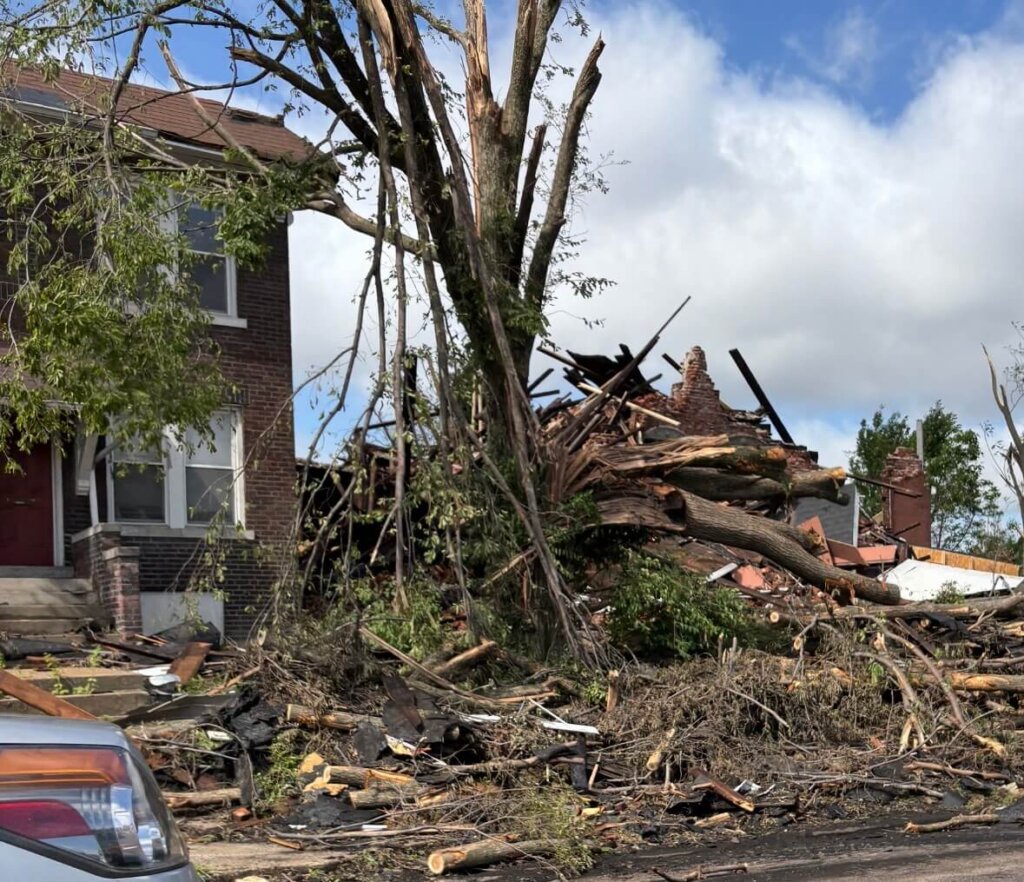
The tornado then reached its peak intensity in the Greater Ville neighborhood, achieving mid-range EF3 winds as it moved along North Newstead Avenue, flattening multiple brick townhouses and shredding everything in a path that had grown to nearly a mile wide. It continued northeast through the O’Fallon corridor, through neighborhoods north of Natural Bridge Avenue, and eventually crossed the Mississippi River into Illinois.
By the time the National Weather Service completed its survey, the damage statistics were staggering: 22.6-mile track, up to 1 mile wide, 152 mph peak winds, 5,000+ structures damaged or destroyed, and five deaths across the path.
The five lives lost:
- Patricia Ann Penelton, killed in the collapse of Centennial Christian Church in Fountain Park, where she had spent years volunteering to feed neighborhood children.
- Larry Patrick, killed in his home on the 4200 block of Margaretta Avenue. He was the former owner of Pat’s Auto Body on Natural Bridge.
- Deloris Holmes, killed in her family home on Cote Brilliante Avenue when the roof was torn off the three-story building her family had occupied for more than 40 years.
- Juan Baltazar, a food truck owner known for his street corn and his service to the St. Louis Latino community, killed when a massive tree fell on his truck in Carondelet Park.
- A fifth fatality confirmed along the path.
These were not abstractions. They were St. Louis people — people who had built lives, run businesses, served their neighbors, loved their families. Their deaths belong at the center of any honest accounting of what this storm cost.
The Failure Nobody Expected: The Sirens Didn’t Sound
One detail that emerged in the immediate aftermath became a defining story of institutional failure: in much of the hardest-hit area of North City, the tornado warning sirens did not activate.
The city’s emergency management commissioner was attending an off-site workshop when the tornado struck. Other emergency staff, according to an external report later commissioned by Mayor Spencer and completed by the law firm Carmody MacDonald, were unable to activate the sirens themselves due to gaps in the city’s emergency protocols. The result was that residents in neighborhoods that faced the most severe damage received no audible public warning before the tornado arrived.
For a neighborhood that does not have universal smartphone penetration, where older residents may not have weather apps or may not have their phones nearby during a Friday afternoon, the absence of sirens was not a minor procedural failure. It was a life-safety failure. The external report released in August 2025 documented the breakdown in detail. Mayor Spencer accepted responsibility and committed to reforming the city’s emergency activation protocols to prevent a repeat.
Where It Hit Hardest: North City and the Cruel Geography of Disaster
If the tornado’s path had shifted even slightly south, it would have torn through the Central West End’s renovated Victorian mansions, the Skinker-DeBaliviere neighborhood’s elegant apartments, and the wealthy institutional corridors near Washington University’s campus. There would have been significant damage — the western portions of the path did touch those neighborhoods at EF1 and EF2 intensity. But the tornado’s path of peak destruction targeted something very different.
The neighborhoods where the EF3 damage was most concentrated — Fountain Park, Greater Ville, Kingsway East, Lewis Place, The Ville, and the O’Fallon corridor — are among the poorest communities in one of the poorest cities in the Midwest.
The numbers that define life north of Delmar Boulevard in St. Louis are stark: median household income of approximately $18,000, compared to $50,000 south of Delmar. Home values averaging $75,000, compared to over $300,000 south of the same boulevard. A population that is over 95% Black — a demographic pattern that is not natural but manufactured, the direct product of 80 years of federal redlining, blockbusting by real estate speculators, and the systematic denial of mortgage capital that prevented homeowners from maintaining their properties and building generational wealth.
Into this community — already carrying one of the highest vacancy rates of any urban area in America, already managing 80 years of deferred infrastructure maintenance, already struggling with the aftereffects of the 2008 foreclosure crisis and decades of disinvestment — the most powerful tornado to strike St. Louis in 66 years arrived and struck hardest.
The pre-existing vacancy crisis made the tornado’s footprint even larger than the damage alone would suggest. Of the 1,407 properties that the city inspected for tornado damage in the days following the storm, approximately 500 to 600 of the 1,000 homes that needed demolition were already vacant before May 16. The tornado did not create all of these problem structures. It destabilized them, converting buildings that had been candidates for eventual rehabilitation into immediate public safety hazards — and adding them to a demolition list that the city’s FEMA agreements did not cover.
The Response: City, FEMA, State, Insurance, Volunteers
The City’s Immediate Response
Mayor Cara Spencer declared a state of emergency within hours of the tornado striking and imposed a curfew on Districts 5 and 6 — the North City police districts covering the hardest-hit areas — beginning at 9 p.m. on May 16. The St. Louis Fire Department conducted immediate search and rescue operations across the damage corridor. The Red Cross opened emergency shelters.
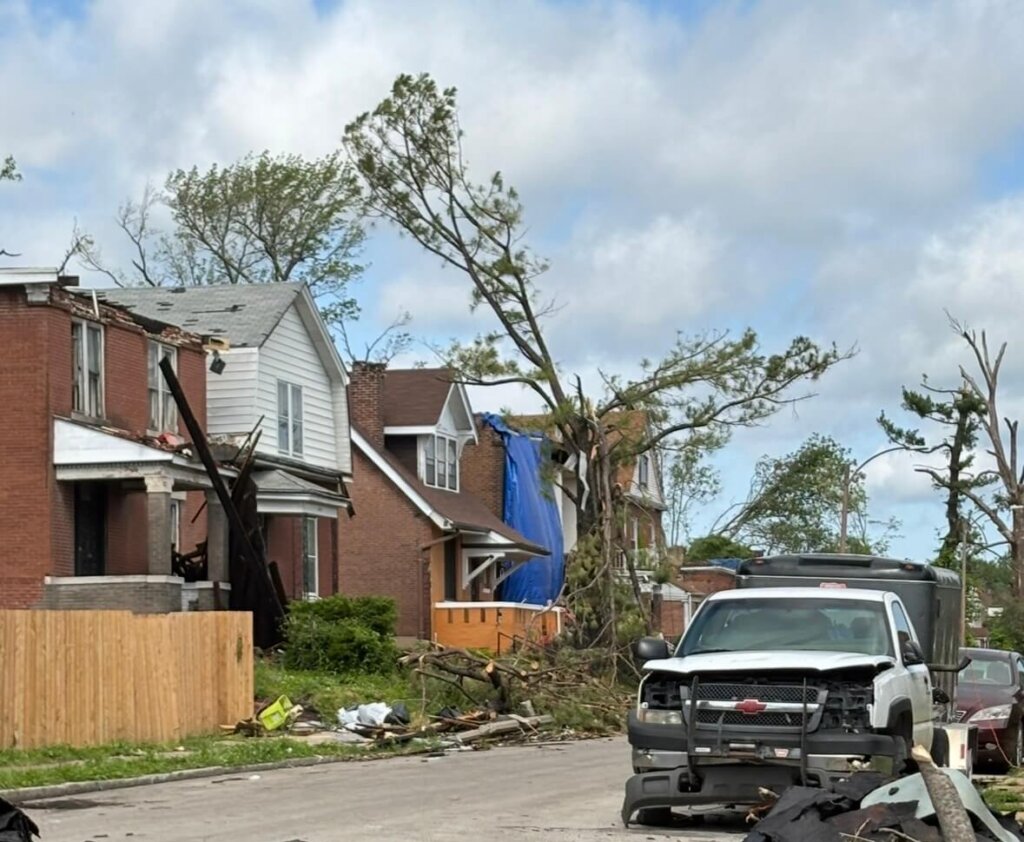
Within the first week, 80 volunteer structural engineers affiliated with the Missouri Structural Assessment and Visual Evaluation (MOSAVE) coalition arrived in the city to assess the habitability of damaged structures, placing colored stickers on buildings: red for unsafe to occupy, yellow for caution, green for habitable. Their surveys were non-binding — intended to inform residents, not to carry legal force — but they provided the first systematic picture of the damage scope.
The city established the STL Recovers outreach center at 4401 Natural Bridge Avenue as a community hub for connecting residents with recovery resources. Emergency shelters opened at multiple locations across the city.
What became apparent in the days and weeks that followed was that the city’s recovery infrastructure was not scaled to handle a disaster of this magnitude. St. Louis has a budget constrained by decades of population loss and a tax base that has shrunk dramatically since the city’s peak population of 857,000 in 1950. The city eventually appropriated $13.7 million in November 2025 for tornado resident housing and winter shelter assistance — a meaningful commitment, but a fraction of what the damage required.
An additional $2.5 million from the St. Louis Rams NFL settlement funds was made available in late 2025 to help rehouse families impacted by the tornado. The use of settlement funds from a decades-old grievance to address an immediate housing crisis was an improvisation born of necessity.
FEMA: The Federal Response That Fell Short
Missouri Governor Mike Kehoe authorized $100 million in state aid for St. Louis recovery efforts and requested a federal disaster declaration from President Trump. That declaration was eventually approved, unlocking federal assistance channels. But the federal response was, by the city’s own accounting, inadequate to the scale of the disaster.
FEMA conducted approximately 15,000 home inspections and approved more than 9,000 households for individual assistance, distributing approximately $48.2 million in individual assistance to homeowners and renters by late September 2025. The U.S. Small Business Administration approved an additional $24.9 million in low-interest disaster loans.
These are real resources that reached real families. But Mayor Spencer was blunt about the gap in December 2025: “Total damages exceeded $2 billion. The city allocated $24 million for recovery. We have about $450 million allocated for $2 billion in damages. That’s not enough.”
The mayor also noted that FEMA’s approach differed significantly from the agency’s response to the 2011 Joplin tornado, where the federal government took a much more active management role in the recovery. “It was clear FEMA was not going to run the response as it did in Joplin, Missouri,” she said.
The most significant FEMA dispute involved vacant buildings. The city learned that FEMA would not reimburse for the cost of demolishing most vacant buildings in the tornado zone — a ruling that left hundreds of dangerous, storm-damaged structures standing because the city could not fund their demolition without federal cost-sharing. This decision, contested by city officials, created a situation where structurally compromised vacant buildings sat deteriorating in already-vulnerable neighborhoods for months after the storm.
Insurance: Who Had It and Who Didn’t
The insurance picture in North City following the tornado revealed one of the most consequential consequences of generations of disinvestment: many residents whose homes were damaged or destroyed did not have homeowners insurance.
This was not financial irresponsibility. It was the predictable result of the economics of the affected neighborhoods. Many homes in North City were passed down through generations and paid off entirely — leaving families without the mortgage-required insurance that would have otherwise been mandatory. In a neighborhood where median home values average $75,000 and household incomes average $18,000, the annual premium for homeowners insurance — which can run $1,500 to $2,500 or more in a high-risk market — represents a genuinely significant portion of income. When families had to choose between insurance premiums and other essential expenses, insurance lost.
Residents with insurance found themselves navigating a system that many described as slow, complex, and in some cases adversarial. One woman who had owned her home on DeGiverville Avenue for nearly 50 years said her insurance covered most of the damage and would provide housing into 2026 — but she worried about neighbors who were not as fortunate. “Insurance covered most of the damage and will put her up in housing well into 2026,” one reporter noted. “But she worries about others who can’t afford insurance and can’t rebuild.”
Residents without insurance faced a more difficult path. FEMA individual assistance for uninsured losses can help with immediate repair needs and temporary housing, but the average payout is dramatically lower than the actual cost of major structural repairs. Families scraped together resources from every available source: employer emergency funds, Red Cross grants, Veterans Affairs assistance, SBA disaster loans, and their own retirement savings.
One North City resident described the process: she gathered $1,000 from her employer, $600 from the Red Cross, $1,000 from VA assistance, $35,000 from FEMA, and withdrew $25,000 from her own 401(k) to fund the repairs to her home. A family friend who worked as a contractor helped her rebuild one room at a time. The roof was finally completed. The den was patched. She still was not able to move back in. “I still see people staying in tents next to their houses,” she said.
Contractors, Scammers, and the Labor Challenge
In the weeks following the tornado, the contractor situation in North City became a genuine secondary crisis. The demand for roofers, structural repair specialists, and general contractors in a limited geographic area, all at the same time, created conditions ripe for price gouging and contractor fraud.
Mayor Spencer signed an executive order in August 2025 specifically designed to remove barriers to legitimate repairing and rebuilding in tornado-impacted neighborhoods — streamlining permit processes, waiving certain fees, and attempting to create conditions that would encourage legitimate contractors to work in the affected areas.
But for residents without insurance or with inadequate coverage, even legitimate contractor prices for major structural repairs were out of reach. Roofing alone can run $8,000 to $15,000 in St. Louis. Full structural rehabilitation of a brick home with significant damage can exceed $60,000 to $100,000. Against a FEMA grant of $35,000 and no insurance, the math for many homeowners simply did not work.
The city warned repeatedly about contractor fraud — door-to-door solicitors asking for upfront payments, contractors who took deposits and disappeared, unlicensed workers offering dramatically below-market prices that reflected dramatically below-standard work. In vulnerable communities recovering from trauma, with elderly homeowners often on fixed incomes and limited capacity to navigate the verification process, contractor predation was a genuine and documented problem.
Residents: Resilience Under Impossible Circumstances
Against every barrier that the system placed in front of them, the residents of North City showed what St. Louis people are made of.
On the evening of May 16, as 11th Ward Alderwoman Laura Keys returned home to find her neighborhood devastated, she began clearing debris from the street. Within minutes, 40 of her neighbors had joined her. That scene — spontaneous, communal, unbidden — repeated itself across dozens of blocks through that first weekend. Churches opened as distribution centers. Neighborhood associations organized debris removal. Community organizations distributed food and water.
The Urban League of Metropolitan St. Louis established a dedicated Humanitarian Fund for tornado recovery, collecting donations from across the region. Thousands of volunteers descended on North City neighborhoods in the days and weeks following the storm, clearing tree debris, helping remove damaged materials, and checking on elderly residents.
The business community, too, showed up. Several businesses along Delmar and Natural Bridge that were damaged or destroyed — including “Beyond Sweet Kitchen and Bar” and other enterprises along the Delmar commercial corridor — were described by their owners as total losses. But many committed to rebuilding. “It’s going to take time, but we’re moving forward,” said the CFO of one Urban League Plaza business whose roof was torn off.
The Unequal Recovery: A Tale of Two Cities Within One City
One hundred days after the tornado, a reporter walking the storm’s path from its beginning near Clayton to its peak in the Greater Ville documented something that anyone with eyes could see: the recovery was dramatically unequal.
In Clayton and the Central West End — the western portions of the tornado’s path, where the storm was at lower intensity and where the residents had higher incomes, insurance coverage, and access to capital — cleanup and repairs proceeded relatively quickly. Trees were cleared. Damaged roofs were replaced. Damaged apartment buildings were repaired. Life largely returned to normal within weeks to months.
In North City, eight months after the tornado, residents were still living in homes without roofs. People were sleeping in tents on their own property, refusing to abandon homes that had been in their families for generations even though those homes could not be safely occupied. Blocks that had been devastated in May were still visibly devastated in November, December, and into the spring of 2026.
As Mayor Spencer herself acknowledged, this disparity echoed the city’s deepest structural divisions. “It feels like yesterday, because it looks like yesterday, depending on what side of the street you are on,” said one community member. “On the north side, just one block over from Delmar on Enright Avenue, you can still find people living in homes without windows.”
The structural reasons for this disparity were not mysterious. South of Delmar, insurance coverage was higher, home values supported larger insurance payouts, incomes allowed families to fund the gap between insurance and actual repair costs, and construction lending was more accessible. North of Delmar, each of these mechanisms failed or was absent. The natural disaster exposed — with brutal clarity — the manufactured inequality that had been building in this city for 80 years.
The Personal Property Assistance program, designed to help residents without insurance, had a February 2026 application deadline. By that point, approximately 1,700 property owners had applied — but an estimated 4,900 eligible households had not. The reasons were varied: some did not know about the program, some distrusted government assistance processes rooted in difficult historical experiences, some lacked the documentation required, and some were simply too overwhelmed to navigate the application process. As one community advocate noted, “FEMA dollars may not be fully spent while residents still need support.”
The Future: Will North City Rebuild?
As of spring 2026 — nearly one year after the tornado — the question of what North City’s future looks like remains genuinely unresolved.
The St. Louis Planning Commission adopted the PlanSTL neighborhood revitalization plan for The Ville, Greater Ville, and Kingsway East in December 2025, incorporating input from more than 3,000 community members over an 18-month planning process that had actually begun before the tornado struck. That plan — which includes proposals for new mixed-income housing, commercial corridor investment, green space, and community facilities — now exists as a framework for what recovery could look like if the funding materializes.
The funding remains the central challenge. Mayor Spencer put the total damage figure at over $2 billion. The assembled recovery resources — $52 million in FEMA individual assistance, $30 million redirected from the NFL Rams settlement, $100 million from the state of Missouri, and $24.9 million in SBA loans — total approximately $207 million. Against $2 billion in damage, that is a roughly ten-to-one gap that must be filled by insurance, private investment, philanthropy, and future federal and state allocations that have not yet materialized.
There are two scenarios that seem most plausible for North City’s tornado-impacted neighborhoods, and they are not mutually exclusive.
Scenario one: Sustained community-driven rebuilding. In this scenario, the combination of the PlanSTL framework, ongoing investment by community development organizations, local private buyers willing to renovate and sell to families, and additional federal and state resources creates enough activity over the next three to five years to meaningfully restore the affected neighborhoods. This scenario is possible. It requires sustained political will, continued community advocacy, and private sector investment that is willing to accept modest returns in exchange for the satisfaction of genuine community impact.
Scenario two: Accelerated disinvestment and displacement. In this scenario, the combination of inadequate recovery resources, predatory outside investors buying damaged properties cheaply from desperate owners, the long-term suppression of property values by remaining vacant and damaged structures, and the departure of residents who conclude that the system will not help them creates a new wave of population loss in neighborhoods that were already losing people before May 16. This scenario is also possible — and without the deliberate policy intervention described, it may be the more likely outcome.
The danger of predatory development in tornado-damaged neighborhoods is real and documented. When property values are already low, when owners are desperate, and when the recovery process is slow and complicated, opportunistic out-of-state investors can acquire distressed properties cheaply, hold them, and eventually capitalize on any future appreciation — without contributing anything to the community’s actual recovery. This is the same pattern that has contributed to the vacancy crisis in North City for decades. The tornado creates another opportunity for it.
The counterweight to this dynamic is local investment — local buyers, local contractors, local investors who are genuinely committed to the neighborhoods they work in, who renovate properties for the purpose of creating quality homes for families rather than holding assets for future speculation.
Cash Offer Man and Tornado Recovery
At Cash Offer Man, we have been working in North City tornado-affected neighborhoods since the months following the May 2025 storm. We purchased a tornado-damaged property in The Ville from a homeowner who was overwhelmed by the combination of damage, insurance complexity, and the emotional weight of what had happened to her community. She needed a clean, certain path forward. We provided it — a fair cash offer, a fast close, and a clear commitment to rehabilitate the property rather than leaving it as another vacant structure on a struggling block.
That rehabilitation is still in progress, as of this writing. Tornado damage of this severity is not a 90-day renovation project. Structural engineering assessment, permitting, material procurement, and the patient work of bringing a seriously damaged home back to livable condition takes time when it is done right. We are committed to doing it right.
Our approach to tornado-damaged properties reflects the same principles we apply to every home we purchase in St. Louis: honest pricing that reflects the actual condition, no pressure and no games, a commitment to renovation that creates genuine quality housing, and a sale to a family rather than to an investor who will hold it empty. That is how private investment is supposed to work in communities like The Ville — not as extraction, but as genuine contribution to the block-by-block process of making neighborhoods whole again.
If you own a tornado-damaged property in St. Louis — in North City, in the broader tornado corridor, or anywhere else in the metro — and you are trying to decide what to do with it, call us. We will give you honest information, a fair offer, and the respect that you deserve as someone who has been through something genuinely hard. There is no obligation. There is no pressure. There is just a conversation with someone who is genuinely invested in what happens to this city. We buy houses in St. Louis.
What St. Louis Deserves
May 16, 2025, was a day that revealed, with terrible clarity, two simultaneous truths about this city.
The first is that the people of North City are extraordinary — resilient, communal, rooted, and determined. They began clearing their streets before the last cloud had passed. They opened their churches and their basements and their tables to neighbors. They showed up for each other in ways that no government program can replicate or replace.
The second is that the systems built to serve this community have failed it, repeatedly and predictably. The sirens that were supposed to warn people were not activated. The FEMA resources that arrived were not sufficient to the scale of the need. The insurance system left the most vulnerable without coverage. The predatory investors are already circling. The contractors who should be rebuilding homes are being outcompeted by scammers who prey on traumatized homeowners. The political will required to match funding to the actual magnitude of damage has not yet arrived.
The tornado did not create the inequality it exposed. Redlining created it in the 1930s. Blockbusting deepened it in the 1950s and 1960s. Interstate highway construction through living Black neighborhoods accelerated it in the same era. The 2008 foreclosure crisis compounded it. And every year of inadequate city resources, absentee negligence, and the slow grind of population decline sustained it.
The tornado simply made it impossible to look away.
North City deserves a recovery that matches the scale of what was lost — not just the physical structures, but the community stability, the generational homes, the businesses, the churches, and the sense that this part of St. Louis is as valued as any other. Whether that recovery comes depends on whether the people who can make it happen decide this community is worth the investment it deserves.
I believe it is. I have seen what these blocks were and what they still could be. And I am one small part of the effort to make that possible, one house at a time.
Aaron Eller is the founder of Cash Offer Man, a local home buying company serving St. Louis City, St. Louis County, and surrounding Missouri communities. Cash Offer Man purchases tornado-damaged and distressed homes throughout the St. Louis area for cash, with closings in as little as 14 days. For a no-obligation conversation about your tornado-damaged property, visit CashOfferMan.com.
Get An Offer Today, Sell In A Matter Of Days